
An answering service is a paid phone desk that picks up your calls when your crew can't, and the good ones book the job while the caller is still talking. That single ability decides whether the fee pays for itself. Owners tend to shop on price. The number to watch sits further down the page: how many calls became jobs on your calendar, and how many were handed to you because the person on the other end refused to guess. Business answering services split into three models with different costs and different failure points, and the rest of this guide walks through each one, the questions to put to a provider, a test week you run yourself, and the red flags that should end the conversation.
Table of Contents
- What a business answering service does for your business
- The three types of business answering services
- What a business answering service can handle
- How much does a business answering service cost?
- Questions to ask before you sign
- How to test the service in your first week
- Red flags that should stop the deal
- Choose your setup and brief the service
What a business answering service does for your business
A business answering service answers the calls your team can't reach, and it can put the job on your calendar before the caller hangs up. That is the product in one sentence, and it is what the monthly fee should buy.
Four things change in the first month. Fewer jobs lost to voicemail, because every ring gets answered in your business name. Jobs booked while you're under a sink or up a ladder, since the caller picks a day and time with whoever answers. Routine questions handled without stopping work, covering hours, service area, and how soon someone can get out. Emergencies passed to your cell while other callers keep waiting, so a burst pipe reaches you and the price question gets handled later.
The mechanics are plain. Your business line forwards to the service after a set number of rings, or only when you don't pick up. The agent or voice agent follows the details you supplied, then writes the booking into your calendar.
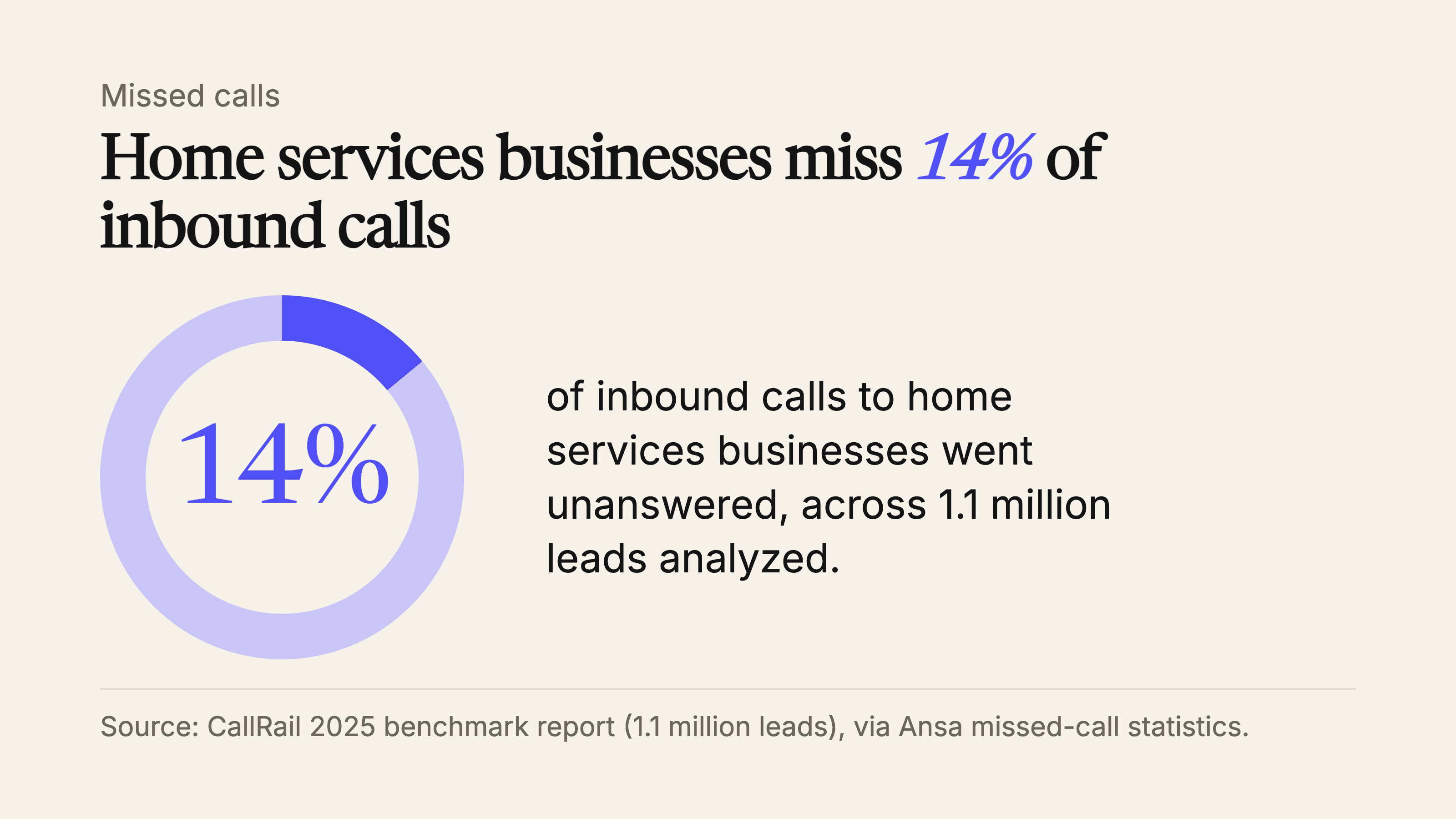
The gap it closes shows up in industry data. Home services businesses missed 14% of inbound calls in CallRail's 2025 benchmark report, which analyzed 1.1 million leads, according to the missed-call statistics published by Ansa. For a plumber or an electrician, that missed call is an estimate request, a routine visit, or a burst pipe at 9pm.
A missed call rarely stays a missed call. The caller dials the next name on the list, and that company gets the estimate. What happens when nobody answers the phone is a lost job you never see in a report, because the caller never became a lead in the first place.
Coverage changes your day more than it changes your phone bill. You stop interrupting a job to take every ring, and the details still land where you can see them. If you want a person on the line around the clock, 24/7 live answering for contractors explains that model and where it fits.
The decision comes down to three things: which type of service suits your calls, what the price works out to per booked job, and how well it handles the calls it should refuse to guess at.
The three types of business answering services
Business answering services come in three models, and the right one depends on what you want a call to produce. Here is the comparison before you talk to a single salesperson.
| Type | Who answers the call | What it typically handles | Watch for |
|---|---|---|---|
| Live answering service | Trained agents in a call center, often serving many businesses | Message taking, basic questions, call transfers | Agents who know little about your trade and scripts that sound generic |
| Virtual receptionist | A named receptionist or a small team dedicated to a few accounts | Message taking, appointment booking, intake questions, transfers | Coverage hours and response times that vary by provider |
| AI answering service | An AI voice agent that answers as your business | Booking and rescheduling, price and service-area questions, after-hours coverage, emergency escalation, bilingual calls | Setup details that are out of date and escalation rules that were never agreed |
Live answering service. A call center employs trained agents who follow a script and take messages for many businesses at once. They do message taking and warm transfers well. The risk is thin trade knowledge, because an agent covering a dozen industries can miss the difference between a failed sump pump and a blocked drain. Expect to write the script yourself and revise it after the first month.
Virtual receptionist. A named person or a small team works with a handful of accounts, learns your services, and asks your intake questions before booking. This is the closest thing to hiring a front desk without the payroll. Ask which named person answers your line, what hours they cover, and how far response times stretch at peak.
AI answering service. A voice agent answers in your business name and follows the details you loaded. It books and reschedules appointments, answers price and service-area questions, covers nights and weekends, and escalates emergencies under rules you agreed. It handles Spanish calls without adding a second queue. The weak point is upkeep, since a price change nobody loaded will be repeated to callers all week.
Four factors settle the choice.
- Call volume. Heavy volume makes per-minute billing expensive fast. Light volume suits a monthly fee with an allowance.
- How many calls should end in a booking. When most callers want a slot, pick a model that writes straight to your calendar.
- After-hours share. A firm taking 8pm emergency calls needs night cover. An office with quiet evenings may not.
- Spanish calls. Treat a second language as a coverage requirement, since a translated greeting leaves the caller without intake in their own language.
Many providers blend the models. A common setup is a live team during business hours and an AI agent overnight, with one calendar behind both. Every model leans on the details you supply, so budget an hour to write your services, prices, hours, and emergency rules before the first call arrives.
What a business answering service can handle
The routine work is broader than most owners expect, and it is where the hours come back. Every item below removes a small interruption from your day.
- Message taking. Name, number, address, and what the caller needs, written into a transcript you can read in ten seconds.
- Booking and rescheduling. The caller names a day and slot, and the appointment lands in your calendar during the call.
- Price and service questions. Diagnostic fees, hourly rates, minimum job sizes, and how estimates work.
- Service-area checks. The caller gives a suburb or postcode, and the service confirms whether you travel there.
- Budget screening on larger jobs. A roof replacement caller gets asked about scope before you spend an hour on a site visit.
- After-hours and weekend cover. Evenings, holidays, and storm weekends, which is when emergency work arrives.
- Spanish calls. Full intake in Spanish, with the same questions and the same booking.
- Spam screening and returning callers. Robocalls get filtered, and repeat customers skip questions they already answered.
- Intake for law firms. Matter type, opposing party, deadline, and conflict details before the file reaches an attorney.
- Notes and transcripts after the call. Caller details written into your CRM or calendar with a summary attached.
Where the service has to stop
Some calls should never be settled by a receptionist or a voice agent. An active leak, a burning smell at a panel, a house with no heat and a newborn inside, an injury, a court deadline inside 24 hours. These calls carry liability, and a wrong answer costs more than the whole subscription.
An escalation rule reads like this in practice: when the caller describes an emergency on your list, the call transfers to your cell within seconds and routine callers keep waiting. Everything else follows your normal booking path.
| Trade | What counts as an emergency | Where the call goes |
|---|---|---|
| Plumbing | Burst pipe, active leak, sewage backup, no water at all | Owner's cell first, then the on-call tech |
| HVAC | No heat in cold weather, no cooling for a household with an infant or elderly resident, burning smell | Owner's cell |
| Electrical | Sparking outlet, burning smell at the panel, downed line, exposed wiring | Owner's cell, then the utility |
| Roofing | Water entering the house, storm damage that exposes the interior | Owner's cell |
| Law firm | A filing deadline inside 24 hours, a client in custody, a summons with a short response window | The named attorney |
| Real estate | A lockbox failure before a showing, a burst pipe at a listed property, a buyer locked out at the door | The agent on duty |
The rule that prevents most complaints: the service stops booking the moment a caller describes something dangerous, a legal deadline, or a medical-sounding problem, and it transfers.
Escalation is also the part of automation that buyers worry about most. More than 20% of AI-using firms in the 2025 Small Business Credit Survey cited accuracy, adapting systems to the business, data security, and training time as barriers, per the Federal Reserve Bank of Philadelphia's small business AI research. The same research cites a 2025 Verizon survey finding 38% of surveyed SMBs using AI across multiple functions and 24% using AI-powered digital assistants for customer service. Worth pairing your escalation rules with scheduling software that connects to your calendar, because a booking rule only works if the availability data behind it is right.
What the service cannot do matters as much. It won't quote complex work, judge scope from a photo, or replace the on-site estimate. A provider without written escalation rules will either pass every call to you or pass none.
How much does a business answering service cost?
Most providers bill one of three ways: by the minute, by the call, or by a flat monthly fee with an allowance. Your monthly bill depends on how many calls arrive and how long each one runs, so the plan name tells you very little.
| Billing model | How the bill works | Where it climbs | Ask before you sign |
|---|---|---|---|
| Per minute | You pay for each minute a call lasts, sometimes with a monthly minimum | Long quote conversations and callers who keep talking | The per-minute rate and whether calls are billed in full-minute blocks |
| Per call | A flat rate for each answered call | Busy weeks, spam and wrong numbers | Whether spam, wrong numbers and hang-ups are charged |
| Monthly fee with an allowance | A fixed fee covers a set number of minutes or calls | Storm weeks, ad campaigns and seasonal spikes | The overage rate and what the service does when the allowance runs out |
| Unlimited monthly fee | One fee covers all answered calls | Only when add-ons are added | Whether booking, calendar connections or extra numbers carry a fee |
| Add-on fees | Setup, extra phone numbers, after-hours cover, Spanish calls, calendar and CRM connections | Multi-location or bilingual setups | Which items sit outside the base fee |
Where each billing model gets expensive
Per minute punishes the calls you want most. A caller describing a leak in detail takes longer than a wrong number, so the model charges you more for the job that pays best. It also rewards short, rushed intake.
Per call is predictable until a storm week doubles your volume. Spam and wrong numbers are answered calls, and some providers charge for both, so read that line closely.
An allowance looks generous on paper. Ask what happens on call 251 of a 250-minute plan, because some services keep answering and stop booking new appointments until the month turns over. That is the worst outcome available: callers think they booked, and nothing reaches your calendar.
Unlimited plans stay cheap until you add a second number, a Spanish line, or a calendar connection that carries its own fee.
Compare the cost of a booked job
Judge every quote by one number: the cost per booked job. Divide the monthly bill by the appointments that landed on your calendar, and compare that across providers.
- Overage rate, stated in writing, with the price per minute or per call beyond your allowance.
- Spam and hang-up charges, since a screened robocall should cost you nothing.
- After-hours and Spanish surcharges, which many providers bill as premium time.
- Setup and integration fees, plus anything charged for connecting a second calendar or CRM.
- What happens at the allowance, whether answering continues, and whether booking continues with it.
Say a shop gets 120 calls a month and each call lasts about three minutes. That is roughly 360 billed minutes. Put that figure beside every allowance and per-minute rate before comparing quotes, and the plans sort themselves out.
Send your last month's call count and average call length to each provider and ask for a written quote on those numbers. Then get the same quote from two more. A low per-minute rate with three add-ons can outrun a flat monthly plan once volume rises, and the only way to see it is side by side.
Questions to ask before you sign
Put these to every provider and write the answers into the agreement, because a sales call covers availability and a contract covers what happens at 2am on a Sunday.
- Booking. Can you book straight into my calendar during the call, which calendars and CRM systems do you connect to, and can you reschedule a job when a customer calls back?
- Coverage. What hours do you answer, who covers holidays, and can you take a call in Spanish?
- Escalation. What counts as an emergency for my trade, how fast does it reach my cell, and how does a caller reach a human at 2am?
- Pricing. What happens when my minute allowance runs out, and which fees sit outside the base rate?
- Disclosure and privacy. Are callers told they're speaking with an AI, do you record audio or only transcribe it, how long are transcripts kept, and who inside your company can read them?
That last group matters more than buyers expect. A 2025 survey of U.S. small businesses reported that 51% had integrated AI into customer-service operations, while only 34% disclosed AI use to customers, per Talkdesk's small business AI survey. Callers hand over addresses, budgets, and legal details, and they deserve to know what's answering.
Add one technical question about caller ID. Ask whether the verification attached to the incoming call survives forwarding, and which number shows when the service calls a customer back. The FCC's STIR/SHAKEN guidance for voice providers explains that authentication proves the displayed number is authorized, which helps your carrier label or block spoofed calls. Aggressive blocking can also suppress genuine local leads, so ask how screening is tuned.
Demand this proof before money moves: a call to a number set up with your services, your prices and your hours, transcripts you can read, plain pricing, and a money-back period.
A provider that scores well on paper can still fail on day two. An evidence-based vendor scoring framework helps you weigh references, contract terms, and exit clauses against each other instead of picking on the lowest headline rate. Score the answers, not the pitch.
How to test the service in your first week
Run the test week yourself, from your own cell, and treat each call as a customer would. The point is to find the failure while the contract still has an exit.

- Call your own line from a cell. Listen as a first-time customer. Check that the greeting uses your business name, your trade, and your town.
- Ask a price question about a common job. A diagnostic fee or a standard installation. Check the answer matches what you'd say.
- Book a routine appointment and name a day and time. Then confirm the booking is on your calendar with the right address and phone number.
- Try to book a job outside your service area. Check the caller is told no politely and offered the nearest town you do cover.
- Describe an emergency and time it. Use a burst pipe or no heat with a baby in the house. Check how long it takes to reach your cell.
- Call once in Spanish. Check the details are captured accurately, rather than a greeting followed by a scramble.
- Check your calendar after every call. Look for duplicate jobs, wrong slots, and missing contact details.
- Read the transcripts at the end of the week. Correct any price, hour, or policy the service got wrong, and send the correction in writing.
A pass looks specific. The booking appears on your calendar within minutes, the emergency reaches your phone in a couple of minutes, and no two crews get sent to the same address.
Here is the walkthrough if you'd rather watch the sequence once before you start dialing.
When a test fails, resist the urge to cancel the same day. Send the correction in writing, wait a day, and repeat the identical call. A provider that fixes it on the second attempt is usually fine. A provider that repeats the same error after a written correction has told you how the rest of the year will go.
Record the time of each call and keep the transcript. A dated log turns a vague complaint into something a support team can actually fix.
Red flags that should stop the deal
Most bad purchases announce themselves before the contract. Three patterns are worth walking away from.
The demo that never becomes your line
The provider shows a polished recorded call and won't let you ring a number configured with your services, prices, and hours. The voice never mentions your trade, and nobody can say what happens when a caller asks for a human. You end up paying monthly for a voice that describes somebody else's business.
The contract that grows after signing
Per-call fees, after-hours surcharges, or charges for an extra number appear after the ink dries. The term auto-renews with no exit in the first 30 days, there's no money-back period, and nobody will answer in writing what happens when the minute allowance runs out. That last silence is the expensive one, because it usually means booking stops.
The first month that books nothing
Bookings land without an availability check, so two crews arrive at the same address. The monthly report shows plenty of calls answered and very few jobs booked. The provider can't show a call log from a business like yours.
A service that answers every call and books nothing has sold you a message pad with a monthly fee.
Two or more of these and the conversation is over. Before the test call, get the exit terms in writing: notice period, refund window, and who owns the transcripts when you leave.
Choose your setup and brief the service
The choice is simpler than the sales pages suggest. If most of your calls are messages and transfers, a virtual receptionist covers it. If calls need booking, service-area checks, after-hours cover, and Spanish intake, an AI answering service fits better. If intake is complex or legal, pair a receptionist with human review of unusual calls.
The setup keeps your own number. Calls forward to the service after a set number of rings, when the line is busy, or outside your hours, with your calendar and CRM connected behind it. The call forwarding service setup takes minutes on most business phone systems, and you can switch between after-hours-only and all-calls coverage by changing one rule.
What makes the voice sound like your business is the detail sheet you send before the first call.
- Services, listed in the words customers use.
- Prices or price ranges, including diagnostic fees and minimum job sizes.
- Service area, with the towns and suburbs you cover and the ones you don't.
- Hours, including holidays and storm weekends.
- Policies on cancellation, deposits, and warranties.
- Emergency definitions for your trade, with the cell number each one routes to.
Ansa's AI receptionist Sarah answers in English and Spanish, books into the calendar you already use, and sends emergencies to your phone. Ansa has answered over 2 million calls for local businesses and is trusted by over 640 across the US and Canada. Every plan carries a 14-day money-back guarantee, and the AI answering service details sit alongside the plans.
The next step is a quote built on your own numbers. Send last month's call count and average call length, ask for the written price, and run the test week before the contract starts.
Ansa's receptionist answers every call, asks your exact intake questions, and puts the booking straight into your calendar, which is the result that pays the fee. Hear Sarah answer a call set up with your own services and prices before you forward anything. Visit Ansa to start.