
An answering service for contractors picks up the business line when nobody on the crew can, books routine estimates and inspections during that call, and puts real emergencies through to the owner's cell. Those three outcomes are the whole job, and they're the only tests worth running when you decide whether to pay for one.
The expensive loss isn't the 2 a.m. burst pipe. It's the ordinary estimate call at 10:40 on a Tuesday, the one that rings in a pocket while the owner is standing on a roof. Storm calls feel urgent, so people cover them. Routine estimate calls feel optional, so nobody does.
That gap is what this guide prices, tests and, in most cases, closes.
Table of Contents
- What an answering service changes for a contractor
- How much does an answering service cost?
- Which calls get booked and which reach you
- How to set up call forwarding and rules
- Questions and red flags before you sign
- Start with unanswered calls and four tests
What an answering service changes for a contractor
What changes is simple. Every call gets answered, routine jobs land on the calendar during the call, and genuine emergencies ring the owner's phone instead of sitting in a voicemail box. For a plumber under a sink, an HVAC owner on a roof curb or an electrician inside a live panel, that's the difference between a job on the books and a homeowner dialing the next name on the list.
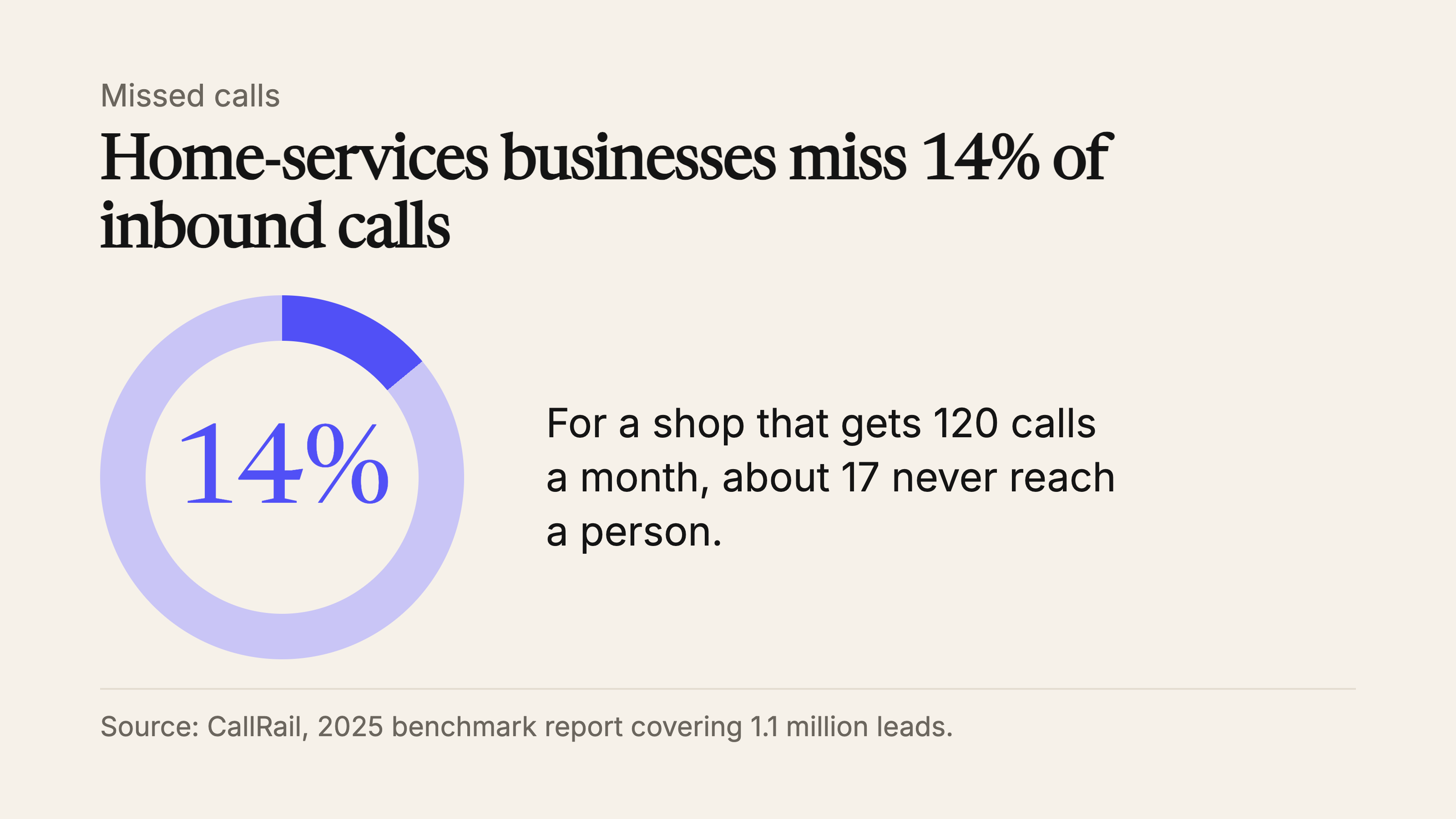
Start with the size of the leak. Home-services businesses miss 14% of inbound calls, according to CallRail's 2025 benchmark report covering 1.1 million leads, as published on the missed-call statistics page. CallRail is the original publisher of that figure. The measure counts inbound calls generally, so it covers daytime interruptions as well as calls placed after dark.
Take a hypothetical shop that gets 120 calls a month. At 14%, about 17 of those calls never reach a person. Some callers leave a message. Plenty don't. They call the next contractor, and the first one to pick up usually gets the estimate.
Routine jobs get booked while the caller is still talking. The service collects the address, the job type and the urgency, checks the address against your coverage map, then offers a slot from the crew's calendar. A booking made on the call beats a callback every time, because callbacks compete with tomorrow's emergencies for the same hour of your attention.
A caller with water on the floor will not wait for a callback. A caller who wants a furnace tune-up will happily take Thursday at 9 if someone offers it while they're still on the phone.
Emergencies reach the owner. A gas odor, an active leak, a burning smell at a panel: those calls ring a mobile number you picked. The routine queue keeps moving in the background.
The service is the layer between the ringing phone and the crew. It answers, qualifies, books and escalates, and it keeps a written record of what was said. The Delgado Construction case study follows answer rates and booked walkthroughs across a full year of that work.
Late-day demand hits other trades the same way. Catching cleaning leads after 5 PM covers the problem from the cleaning side, where the same phone behavior shows up.
Judge every vendor on three outcomes: a routine job on your calendar, an emergency on your phone, and a written record of the conversation. Everything that follows tests against those three.
How much does an answering service cost?
There's no single price, so the only number worth arguing about is the written all-in monthly figure for your call volume. Ask for it in writing, then check the allowance, the after-hours terms, and what happens when the allowance runs out.
Two pricing shapes dominate. A live answering service usually charges a monthly base plus a rate per minute or per call, and nights, weekends and holidays often bill at a higher rate. An AI receptionist usually charges a flat monthly fee, with a tighter cap on the entry tier and fuller booking on the tier above.
Read six lines on any pricing page before you compare anything else:
- The allowance. Minutes or calls, stated in writing, with the number printed on the quote.
- The behaviour after the cap. Either booking continues or the service drops to message-taking. Ask which one you're buying.
- After hours and holidays. Either inside the monthly price or billed at a night rate. Get the answer for Thanksgiving, not just an ordinary Tuesday.
- Setup and seats. Any onboarding charge and any per-person fee belong on the page.
- Languages. Spanish included in the base plan, or billed as an extra and handled by whoever is on shift.
- How you leave. Month to month, with the cancel path named out loud. Ask whether an annual term applies.
Bring your own numbers to that conversation. Say a shop takes 120 calls a month and the average call runs a few minutes. The vendor should convert that into a minute estimate using your own average call length from one recent week, with the arithmetic shown on the page.
| Cost question | What a clear plan states | What to watch |
|---|---|---|
| Minutes or calls included | The monthly allowance in writing | A low cap that stops booking mid-month |
| After the allowance | Whether booking continues or only messages are taken | A silent change in what the service does |
| After hours and holidays | Covered by the same monthly price | A separate night or weekend rate |
| Setup and seats | Any setup or per-person fee listed up front | Hardware or onboarding charges added later |
| Languages | English and Spanish in the base plan | An extra fee or a transfer to someone off duty |
| How you leave | Month to month, with the cancel path named | An annual term or a fee to stop |
A low base can hide a night premium, a per-transfer charge, or a quiet switch to message mode in week three. Any one of those three costs more than the gap between two base prices. The answering service price breakdown works through how each billing shape behaves as volume climbs.
Treat all of this as a budget guide. This article prints no competitor rate, because a price copied from someone else's marketing page tells you nothing about your own bill. Get one written all-in number for your own call volume, and hold the vendor to it.
Which calls get booked and which reach you
Estimates, inspections and routine repairs get a time on the spot, as long as the address sits inside your service area and the job is one your company does. Active damage goes to your cell: water entering the house, a gas odor, a live electrical hazard. That single rule decides every call.
Two checks come before any slot is offered. The city has to be in the coverage map, and the trade has to be work you take. Confirm both, then offer the next open estimate. When either answer is unknown, the right move is a callback request: the question written down and sent to you by text or email. A service that guesses at a price or promises a policy you don't have hands you a fight to settle later.
A routine call, booked. Say a homeowner rings at 7 p.m. and wants a water heater estimate. The address is inside the map and water heaters are your work. The service offers the next open estimate, writes it into the calendar, and sends a booking notice to your phone before the caller hangs up.
A real emergency, escalated. Say the next caller has water coming through the kitchen ceiling. That call rings your cell. The routine queue keeps moving behind it, so the tune-up call still gets a Thursday slot.

The after-hours share runs larger than most owners guess. A 2026 sample of nearly 150,000 calls handled for home-service contractors found that 45.7% arrived outside standard business hours, according to the ServiceForge after-hours call analysis. Weekday edges before and after normal hours made up 29.5% of the total, and weekends another 16.2%. Those numbers come from one answering operation's sample, so read them as a benchmark for where demand lands.
Where the booking gets written
Book straight into Google Calendar, Jobber or Housecall Pro while the caller is on the line. A message saying "caller wants an estimate, number attached" is a lead your office has to handle a second time tomorrow. A calendar entry is a job with a name and a time on it.
Returning callers should be able to move an appointment without a full intake again. Spam and vendor calls get screened out before they cost you anything. A caller who starts in English and switches to Spanish halfway through should finish the booking in Spanish, with the same address and trade checks applied.
The walkthrough below shows the two paths a call can take.
| Call type | What happens | Who is contacted |
|---|---|---|
| Estimate or inspection | Book the next open slot if the address and trade match | Caller gets a time and the owner gets a booking notice |
| Routine repair | Book if the company does that work and a slot is open | Same as an estimate |
| Active damage or safety risk | Do not book it as a normal visit | Owner's cell immediately |
| After-hours non-emergency | Book the next open slot | Owner reviews the transcript later |
| Outside the service area | Do not offer a crew time | Callback only if the owner wants those leads |
| Spam or solicitor | Screen the call out | Nobody on the crew |
| Spanish-speaking caller | Use the same booking rules in Spanish | Same contacts as an English call |
The speed penalty for a slow handoff
An estimate that books an hour late costs real money. Organizations attempting contact within one hour were nearly seven times more likely to qualify a lead than organizations waiting an additional hour, according to an analysis summarized in this lead response time breakdown. Against companies that waited a full day, the gap widened past 60 times.
Qualification in that study meant a real conversation with a decision maker. A web form and a call record don't count on their own. That's the case for answering and booking on the same call, with no callback queue sitting in between.
Track three numbers every week: calls answered, bookings completed, and emergencies escalated. Then track call conversion rates so a busy line and a productive line show up as separate figures on the same report.
Judge any service on the two calls above before you sign. A routine job has to land in your calendar while the caller is still on the line, and a true emergency has to reach your cell without sitting in a queue. Get the written all-in quote, confirm both behaviors in it, and refuse anything that books slow or escalates late.
How to set up call forwarding and rules
Forward only the calls you miss, keep your existing number, and let the service book into the calendar your crew already opens every morning. Eight steps cover the setup, and the forwarding part itself takes minutes.
- Keep the business number. Forward only unanswered calls at first, or forward every call if you want coverage from day one.
- Confirm the path. No new hardware to buy. Forwarding happens on the carrier side or through the service's own routing.
- Correct the details. Go through services, hours, prices, service area and the emergency definitions. Fix anything copied from a website page you wrote two years ago.
- Write emergencies in plain words. "Active leak." "Gas odor." "No power to the whole house." Vague categories get missed at 11 p.m.
- Connect the calendar or CRM and block the times the crew can't take work. Booking comes ahead of every other extra, because a booked estimate is the point of answering the phone.
- Set the greeting. It should tell the caller whether they've reached a person or an assistant.
- Place four test calls. A routine estimate, an address outside the area, a sales pitch, and an emergency.
- Choose what reaches your phone. New leads can arrive as texts with the job details, while events on your emergency list ring your cell directly.
Read the coverage terms before you assume anything. One subscription typically covers one legal business, one primary service business and the phone numbers approved at setup. An owner with three locations should ask whether each location needs its own setup and its own bill, then get the all-in monthly figure in writing: the plan price, what happens after any included minutes run out, and the cost of a second line.
Decide who loads the rules. A self-service setup lets you enter your own prices, service area and emergency definitions, and change them yourself later. A managed setup hands that work to the provider's team, which configures the responses and adjusts them when your prices or seasons change. Pick the one you'll keep updated, because a rule nobody maintains stops matching the business within a season.

If you want the mechanics of keeping your number in place, this guide to a call forwarding service covers the routing choices in more detail.
Run all eight steps on a quiet week. A forwarding rule that's wrong in April is a small leak. The same rule wrong in storm season costs real jobs.
Questions and red flags before you sign
Don't sign until the vendor passes two live tests: a routine job booked into your calendar and an emergency that rings your phone. A vendor who can't do both on a demo call won't do them on a Sunday night in storm season.
Ask the questions below and listen for the fail column.
| Question to ask | Pass | Fail |
|---|---|---|
| Does the greeting say who is answering? | Caller hears if it is an assistant or a person | Script pretends a person is at a desk |
| Which events ring my cell? | A written list such as active leak, gas odor, or no power | Every call treated as routine, or none transferred |
| Where does the appointment land? | In the calendar or CRM during the call | An email the owner must retype |
| Can I read what was said? | A transcript and summary kept for a stated time | No record, or audio stored with no clear policy |
| Can I test it first? | Test calls for an estimate, out of area, spam, and an emergency | A demo that only shows an easy booking |
The greeting question matters more than it sounds. Callers who believe they're talking to your office describe the problem in office terms, then get annoyed when the person they thought they reached isn't there. A greeting that names the assistant costs nothing and prevents the complaint.
The rule that saves arguments: get the escalation list in writing. Active leak, gas odor, no power to the whole house, a roof open to the weather. Those are events, and each one needs a defined destination.
Define a qualified call in plain words before money changes hands: someone who wants the work your company does. Solicitors, wrong numbers and the window salesman don't count, and no one should book them as jobs.
Keep the first two weeks of transcripts and fix wording that doesn't match the company. Owners who skip that step spend the second month arguing with their own phone line about how they answer it. If a recording practice exists that you can't explain to a homeowner in one sentence, change the practice.
Start with unanswered calls and four tests
Choose on three checks. The service must book into the calendar the crew already uses. A real emergency must ring the owner's cell. The owner must be able to leave without sitting through a sales call.
Start small and stay measurable. Forward only the calls you miss for two weeks, run the four test calls, then count booked estimates and read the transcripts. Keep the service if routine jobs land on the calendar and the emergency test reaches the phone. Drop it if either one fails. Two weeks is enough time to see both.
If missed calls still outnumber booked estimates at the end of that test, recover leads from missed calls before you write off the month.
Ansa runs an AI answering service that answers the business line day or night in English and Spanish. It books routine appointments when the service area and the job match, and on the Self-serve and Done-for-you plans it puts emergencies through to the owner. Sarah takes a callback when she doesn't know an answer and sends the question to the business by text or email.
Turn on forwarding for missed calls this week. Run the four tests. Keep the service only if the estimate is on your calendar and the emergency reaches your phone.
Ansa answers contractor calls around the clock, books estimates and inspections into the calendar the crew already opens each morning, and routes real emergencies to the owner's phone. If last storm season left a stack of voicemails you never returned, that's the gap worth closing first. Visit Ansa to hear Sarah answer a call as your business.