
A 2026 U.S. procurement benchmark from IBISWorld put the average market price of telephone answering services at $2.54 per minute. That average rose at a compound annual growth rate of 3.514076% between 2023 and 2026. A single minute rate is a poor stand-in for the bill you'll sign. The answering service price on a quote is the starting point. Minutes, rounding, transfers, and what happens after an allowance runs out decide the invoice.
Live services still bill three ways: per minute, per call, or a monthly bundle. A flat subscription replaces the meter only when the plan has no usage charge. Lite is $49 a month for 250 minutes and books into Google Calendar. Self-serve is $297 a month with unlimited calls, so a busy month costs the same as a slow one. Done-for-you is $497 a month for one business. The gap between $49 and a $2.54 market minute is real, and it isn't unlimited booking. Match the allowance to your call logs, then check whether appointments keep getting written after the minutes are gone.
Table of Contents
- Answering Service Price Ranges at a Glance
- Three Pricing Models and How Each One Bills
- Hidden Costs That Change the Final Bill
- How Minutes Drive the Monthly Bill
- Comparing Plan Allowances and Included Features
- Calculating Whether a Plan Pays for Itself
- Confirm the Quote Before You Sign
Answering Service Price Ranges at a Glance
Use the bands below as a budget bracket before you request a quote. In 2025, Goodcall put entry-level live answering at $75 to $300 per month and enterprise plans at $800 to more than $2,000 per month. My AI Front Desk put per-call pricing at $1.39 to $2.69. Housecall Pro, citing AMBS Call Center, put most small-business live plans between $135 and $400 per month, the band most owner-operated firms land in.
| Pricing model or plan | Typical price | Best fit |
|---|---|---|
| Per-minute live answering | $0.80 to $2.25 per minute | Variable volume with short calls |
| Per-call live answering | $1.39 to $2.69 per call | Low, steady call counts |
| Entry-level monthly plan | $75 to $300 per month | Businesses taking few calls |
| Small-business live plan | $135 to $400 per month | Owner-operated local services |
| Enterprise live service | $800 to over $2,000 per month | Multi-location operators |
| Ansa Lite | $49 per month, 250 minutes | Low to moderate call volume |
| Ansa Self-serve | $297 per month, unlimited calls | Busy phones with unpredictable volume |
| Ansa Done-for-you | $497 per month, team-managed setup | Owners who want setup and tuning handled |
How to read each row
Per-minute and per-call rows are usage prices. They look cheap on a quiet Tuesday and climb on a storm week. Entry and small-business rows are what a single-location roofer, plumber, or shop usually gets quoted for live coverage. Enterprise is the multi-location tier, not a better script.
Our rows sit beside that market on purpose. Lite is below the entry live band because the allowance is capped at 250 minutes. Self-serve at $297 sits inside the small-business live band, with the meter removed. Done-for-you at $497 is above that band because the team builds the receptionist, trains it on your prices, and keeps tuning it. Enterprise is custom priced, with one setup per location.
These are monthly bands, not quotes. If you are also replacing the phone system under the answering layer, 2026 per-user VoIP pricing from SnapDial is a useful side check so you don't mix line rental into the receptionist bill. Call minutes, after-hours rules, transfers, and add-ons still move the final number.
Three Pricing Models and How Each One Bills
Three meters, three questions. A per-minute plan works like a taxi meter: the bill climbs while the call runs. A per-call plan resembles a cinema ticket: you pay once per interaction, short or long. A monthly bundle resembles a gym membership: the price is set whether you show up once or daily.

Per-minute, the taxi meter
In 2025, answering services commonly charged $0.80 to $2.25 per minute and imposed monthly minimums of about $100 to $200, according to AMBS Call Center. Three short calls a week can still trigger the minimum. Say you take ten calls of four minutes at $1.50 per minute. That's 40 minutes and $60 of talk, and the minimum can lift the invoice above that arithmetic. Per-minute answers one question: how much talk time you bought.
Per-call, the cinema ticket
Each answered call is one fee, so a 40-second "are you open" costs the same as a 12-minute estimate. That's easy to forecast from a call count and harsh on a day of brief inquiries. A shop that knows it gets about the same number of calls every week can budget it. A plumbing company after a freeze cannot. Per-call answers how many calls you pay for.
Monthly bundle, then a flat AI invoice
A bundle spreads a block of minutes or calls across the month and suits steady volume. Unused time usually expires, and a spike can push you into a higher rate. Flat-rate AI billing is the cleaner version of that membership. Self-serve and Done-for-you have no per-call charge, no per-minute charge, no metering, and no overage billing, regardless of call volume. Fifty calls or 500, the invoice doesn't move. If you're weighing that against a staffed desk, our comparison with a human receptionist lays out the coverage difference without mixing it into the rate card.
The short clip below walks through why the meter, not the headline fee, is what owners argue about after the first invoice.
Hidden Costs That Change the Final Bill
The advertised monthly fee is the opening line. Setup, overage, rounding, holidays, and transfers show up later, or only when a condition hits. Ask for each item in writing before you sign.
| Cost item | Typical range | Question to ask |
|---|---|---|
| Setup fee | $50 to $500 one time | Is any setup or implementation charge included? |
| Overage per minute | About $1.75 to over $5.40 per minute | What happens after the included minutes are used? |
| Rounding rules | Can add 20% to 40% to charges | Are calls billed by connected time or rounded increments? |
| Holiday or weekend rate | 1.5 to 2 times normal pricing | Does after-hours coverage cost more? |
| Transfer to a person | $1 to $3 per transfer | Is transferring a call to the owner included? |
| Spanish or bilingual coverage | Included at no extra charge on our plans | Is Spanish coverage included on the plan? |
| Calendar or CRM integration | Included for Google Calendar on Lite; Jobber, Housecall Pro, and GoHighLevel on unlimited plans | Is booking into Google Calendar, Jobber or Housecall Pro included? |
| Billing cycle | 28-day cycles can mean 13 invoices a year | Is billing monthly or on another cycle? |
| Contract term | Annual commitment locks in cost | Can the plan be cancelled month to month? |
The three charges that move a "cheap" plan
Independent pricing guidance on Ready to Talk flags setup fees of $50 to $500, holiday and weekend rates of 1.5 to 2 times normal pricing, and transfer fees of $1 to $3 per call. A one-time setup is annoying. A holiday multiplier on your busiest weekend is the bill you remember.
Overage and rounding do more damage on variable volume. A 2026 comparison on Comms Advisor found overage from roughly $1.75 to more than $5.40 per minute, and rounding that can inflate charges by 20% to 40%. The same write-up notes that 28-day billing can create 13 invoices in a year rather than 12. A lower headline can cost more than a higher flat plan once those rules apply.
Practical rule: If the contract doesn't say whether a 40-second call bills as 40 seconds or as a full minute, you don't have a price yet.
We charge no setup fee and no implementation cost, so the subscription is the only charge on a normal month. There's no per-seat, per-user, per-phone, or per-location fee. You pay one flat subscription, with one owner login and one number. Our plans also have no per-call charge and no overage billing. Live quotes often aren't month to month even when the price is written as a monthly figure, so confirm the term. Ours renew monthly until you cancel.
Carrier charges on notice
One edge remains. We may pass through new or increased carrier or regulatory charges on notice. Ask whether any pass-through is possible, and what notice you'll get, before you treat the subscription as a sealed number.
How Minutes Drive the Monthly Bill
Pull three months of call logs before you pick a tier. Average the minutes, then divide by the days you were open. That baseline, not the brochure, decides the plan.
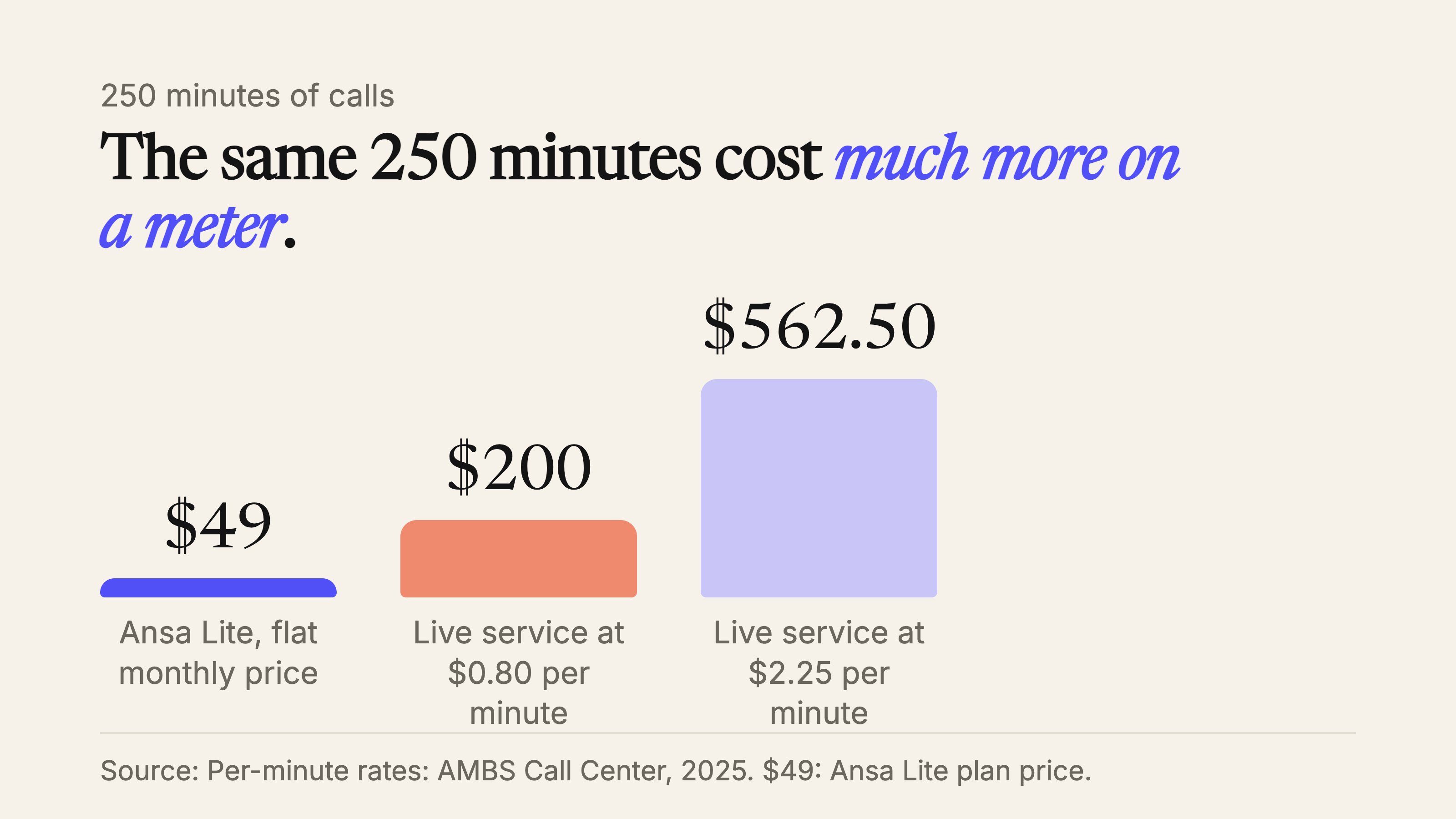
Lite's 250 minutes is about 4.2 hours of talk. Divide $49 by 250 and the included minute is about $0.196. That figure is not a market comparison. Once the allowance is gone, Sarah still answers, but she takes messages until the next month instead of booking. At the common live per-minute band, those same 250 minutes would run about $200 to $562.50 if you used them. You only get that comparison if the live service keeps booking the whole time.
A plumbing month on three bills
Say a plumbing company takes 120 calls averaging three minutes. That's 360 minutes, past a 250-minute allowance.
- Per-minute live service: 360 minutes at $0.80 is $288. At $2.25 it's $810. A monthly minimum can sit under the low end and still not cap the high end.
- Lite at $49: the invoice stays $49. Sarah keeps answering after minute 250 and switches to messages. Callers who needed a slot on the calendar wait until you call them back.
- Self-serve at $297: 360 minutes cost the same as 36 or 3,600. There's no per-call or per-minute charge, and booking doesn't stop.
Inbound calls and the alert texts we send are included, with no per-minute charges. There's no per-call fee and no overage on any plan, so the monthly price stays the same whether you take 50 or 500 calls. On Lite, "same price" doesn't mean "same booking." The behavior change is the actual cost.
What a staffed hour actually costs
The U.S. Bureau of Labor Statistics reports a 2025 median wage of $21.53 per hour for customer-service representatives. About 4.2 hours of talk is roughly $90 in base wages before breaks, benefits, supervision, recruiting, and the idle time between calls. Don't compare a subscription with that $90 and call it a savings study. Compare cost per booked job. The next section turns the monthly fee into that job count.
Comparing Plan Allowances and Included Features
Check average monthly minutes against the allowance, then confirm what happens after the cap, whether booking continues, and which tools are included. Price is the third question, not the first.
| Plan | Monthly price | Call allowance | Booking scope | After the limit or extras |
|---|---|---|---|---|
| Lite | $49 | 250 minutes | Google Calendar | Sarah takes messages until next month |
| Self-serve | $297 | Unlimited calls | Calendar or CRM, including Jobber and Housecall Pro | No change; no overage billing |
| Done-for-you | $497 | Unlimited calls | Calendar or CRM, built by the Ansa team | Weekly improvements and priority support |
| Enterprise | Custom | Custom | Custom integrations for multiple locations | One setup per location |
The one limit that matters on each plan
Lite includes answering every call 24/7, handling FAQs, taking every detail, booking into Google Calendar, and texting you every lead. The limit that matters is the switch to message-taking. If you only need a handful of calls booked onto one calendar, that switch may never arrive.
Self-serve is $297 per month with unlimited calls. Booking reaches a calendar or a CRM such as Jobber, Housecall Pro, or GoHighLevel. Nothing about the invoice or the booking behavior changes when volume rises. The limit that matters is yours: you configure services, prices, and the after-hours rule yourself. Each service has a name, a price, and a switch for whether Sarah can book it.
Done-for-you is $497 per month for one business. The team builds and launches the receptionist, trains it on your prices and policies, tunes the voice to the brand, and makes the later changes. Weekly improvements come from real calls, and support is priority. On this plan the team needs about five minutes of input from you, at no extra cost. The limit that matters is scope: one business, not a chain.
Enterprise is custom priced for several locations, with one setup per location. Don't force a single-location plan to impersonate that.
Every plan answers in English and Spanish, including a language switch mid-call. The feature list is the place to confirm calendar, CRM, and emergency escalation before you compare prices again.
A few calls a day onto Google Calendar points to Lite. More than a few calls a day, or booking into Jobber or Housecall Pro, points to Self-serve. An owner who wants setup and weekly tuning handled points to Done-for-you. Several locations point to Enterprise.
Calculating Whether a Plan Pays for Itself
Divide the monthly plan price by the average value of one booked job, then round up. That count is the number of extra booked jobs that cover the plan. It isn't a promise that those jobs will appear.
| Average job value | Lite ($49) | Self-serve ($297) | Done-for-you ($497) |
|---|---|---|---|
| $150 per job | 1 | 2 | 4 |
| $300 per job | 1 | 1 | 2 |
| $500 per job | 1 | 1 | 1 |
At $500 a job, one booking covers every plan in the table. At $150, Done-for-you needs four. At $300, Self-serve needs one and Done-for-you needs two. A missed emergency call and a missed "what are your hours" call don't share an economics. Use your job value, not a universal dollar figure for every unanswered ring.
What the missed-call evidence does and doesn't say
A 2025 CallRail analysis, as summarized by Eric Vincent Consulting, found missed-call rates from 9% to 32% across industries. Dollar estimates attached to each missed call rest on assumptions, not measured losses. A separate summary of a 2025 survey reported that 78% of consumers had permanently abandoned a business after an unanswered call. That's a survey result. It isn't proof that every missed call is lost revenue.
Inputs you have to supply
Label these as assumptions before you treat the table as your return:
- Average job value. Use completed-job revenue, not the first quote.
- Unanswered and after-hours share. Count the calls you miss, not every call you receive.
- Answer-to-appointment conversion. Only some answered calls become bookings, and only some bookings become paid work.
Reporting includes trends for any date range and CSV exports, so you can check booked jobs against the fee instead of trusting a generic estimate. If you want a structured way to enter your own miss rate and job value, use the missed-call calculator and keep the assumptions visible.
Confirm the Quote Before You Sign
You can finish this in one sitting. The point is to turn a rate card into a document you can compare.

- Ask for a written quote that lists setup, overage, transfers, holiday and after-hours coverage, and Spanish. If a line isn't on the page, it isn't in the price.
- Confirm whether booking continues after any included allowance, or whether the plan switches to message-taking.
- Check Google Calendar, Jobber, Housecall Pro, or GoHighLevel, and whether each one is included or billed extra.
- Confirm the billing term, cancellation rules, and how many invoices a year the cycle produces. An annual commitment is a different product from a monthly price.
- Run a few weeks of real calls before a longer term. We include a 14-day money-back guarantee on the first monthly charge, and paid subscriptions renew monthly until you cancel.
- Compare that written quote with current pricing published at our pricing page, then run the job-count math on the bookings you expect.
The same habit shows up outside phone service. RedAppy's guide to compare shop management software contract terms is a useful parallel if your CRM contract is up at the same time. Your next action is to request the written quote this week, with every charge from the checklist on it.
We built Sarah to answer every call, qualify the job, and book it onto the calendar or CRM you already use, at a monthly price that doesn't meter each minute. If you're comparing an answering service price against missed estimates, start with your own call logs and the plan that matches them. Visit Ansa to see current plans and run the numbers on your phones.