
Business calls go unanswered because the person who answers is on a job, and the phone is in a pocket, on silent, or already busy. The fix is to hand the calls you miss to someone who can answer, book a time, and send the details over.
That explains why the voicemail box is the worst record of what a business loses. A caller who hangs up leaves almost nothing behind: no message, no email, no line in the calendar. An owner can look at a quiet week and call it a light schedule. Eight lost jobs never show up on any report.
Getting this right pays better than most marketing. A job booked from a call you nearly missed costs nothing to acquire.
Table of Contents
- Why does no one answer the business phone?
- What one missed call costs a local business
- How to find where your calls are leaking
- How to forward unanswered calls to Sarah
- What to do in the first few minutes after a missed call
- Choose who answers unanswered calls
Why does no one answer the business phone?
Business calls go unanswered for a short list of reasons, and nearly all of them trace back to one person doing the work. The phone rings while the owner is on a roof, under a sink, driving between jobs, or already talking to another customer.
Common reasons business calls skip the owner
| Cause | What the caller hears | Quick check |
|---|---|---|
| Phone off or out of signal on a job site | Endless ringing or a jump straight to voicemail | Check signal at the main job site |
| Do Not Disturb or Focus mode on | Silence, with no ring and no voicemail prompt | Check Focus schedules for work hours |
| Owner already on another call | A busy tone or a second caller sent to voicemail | Check whether call waiting or a second line is set up |
| Spam filter silenced an unknown number | A first-time customer's call never rings the phone | Check the silenced calls list for new numbers |
The spam filter deserves its own paragraph, because owners rarely suspect it. A new customer calls from a number the phone has never seen. The carrier or the handset labels it potential spam and silences the ring. The customer hears normal ringing and the owner hears nothing at all, so a call that could have become a job disappears without a trace.
When no one answers the phone, the caller has no idea you're up a ladder. They hear four rings, a greeting they've heard before, and a beep. Then they dial the next company on the list.
Three checks you can do in five minutes
- Signal at the main job site. Stand where the truck normally parks and look at the bars. If calls drop to voicemail there, the phone needs to stay with someone who has signal.
- Focus schedule. Open Settings, then Focus, and read the schedule behind Do Not Disturb, Driving, and Sleep. Most phones carry a work-hours rule nobody remembers setting.
- Silenced calls. Open the phone app, tap Recents, and look for entries marked silenced or screened. New numbers in that list are the ones worth worrying about.
Each one is a same-day fix. Signal trouble takes a forwarding rule, Focus takes a schedule edit, and screening takes a settings change.
If the phone settings come back clean and calls still vanish, the problem sits in the line itself. Reading up on choosing a unified communications system helps an owner weigh a mobile handset against a cloud line that can ring three people at once.
What one missed call costs a local business
One missed call usually costs the value of one job, because most callers don't leave a voicemail and dial the next business. A repair is worth a few hundred dollars. A roof replacement or a legal matter runs into the thousands.
The scale of the problem shows up clearly in home services. Home-services businesses leave 27% of inbound calls unanswered, according to Invoca's 2024 analysis cited by Ansa's missed-call statistics page. The same page reports that fewer than 3% of callers sent to voicemail leave a message, based on observed home-services call data from Invoca. A caller who reaches voicemail almost never leaves a usable record behind.
Calls go missing while technicians drive, work onsite, or handle another customer. Nobody decides to skip the phone. It rings at the worst moment of the day.
The cost follows a straight line from the missed ring to the empty slot on the calendar.
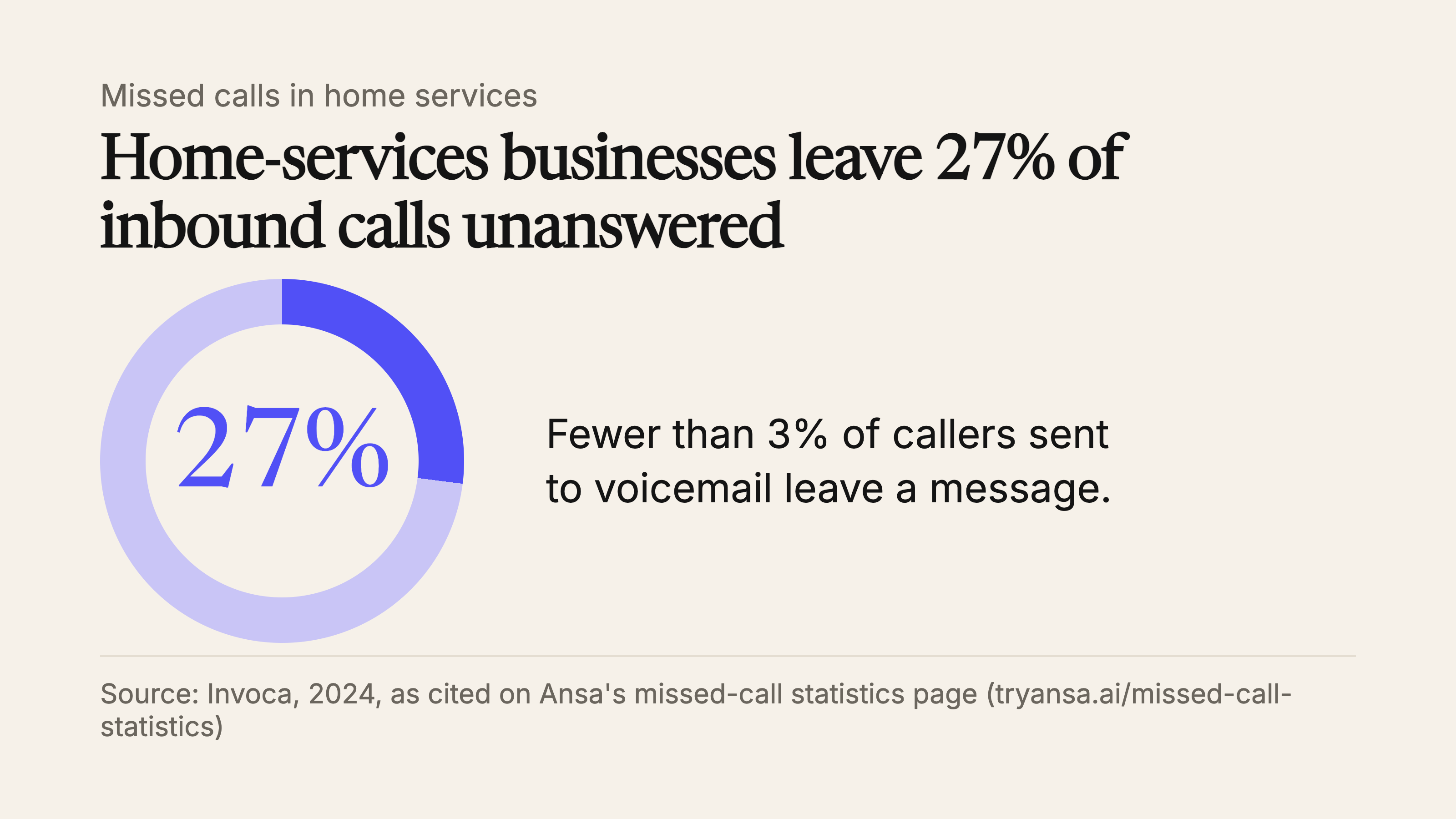
Say a home-services shop gets 120 calls a month. At 27%, about 32 of those calls go unanswered, and fewer than one of those 32 callers leaves a message. At a few hundred dollars a job, that's thousands of dollars of work the shop never heard about, and the owner never gets the chance to quote it.
Counting your own line takes ten minutes. Add up missed calls and voicemail transfers for one month, then multiply by the average value of a job. The missed-call calculator does the arithmetic from a monthly call count and an average job value. That dollar figure is the budget available for answering, and it usually dwarfs the cost of covering the gap.
How to find where your calls are leaking
The hour a call goes unanswered tells you what broke. Misses bunched at lunch, after five, and on weekends point to coverage. Misses spread evenly through the day point to a routing fault. Calls from the same number that never leave a message are usually spam.
Start with the call log, and leave the shopping for a new service until after that.
Run the five-minute audit
- Add up the misses. Open the phone app, tap Recents, and count every missed call and every call sent to voicemail across the last 30 days.
- Count the messages. Count the voicemails people left, which sit in their own tab on most phones.
- Subtract. The gap between misses and messages is the number of callers who hung up. That gap is the leak.
- Call yourself. Dial the business line from another phone at lunch, after five, and on a Saturday. Time the rings before voicemail picks up.
- Listen as a customer. Note what the greeting says, whether it names the business, and whether it offers any next step beyond a beep.
To hear a change before customers do, run the test call yourself and ask the question a customer would ask. A greeting that says "leave a message" tells the caller nothing about whether anyone will call back.
Match the pattern to the cause
Missed-call patterns and what they point to
| Miss pattern | What it usually means | First fix |
|---|---|---|
| Clusters at lunch, after five and on weekends | Coverage gap when the team or owner is busy or closed | Forward unanswered calls during those hours |
| Spread evenly through the day, very short ring times | Forwarding or routing fault | Check forwarding settings and test from another phone |
| Repeated calls from numbers that never leave a message | Usually spam or robocalls | Screen or block those numbers |
Say a plumbing shop misses most calls between noon and one, and again after five. That shop has a coverage gap. Forwarding only the calls missed in those hours closes it, and the phone still rings on the owner's hip the rest of the day.
When the pattern is mixed, fix routing first. A routing fault loses calls the owner could have answered, so it wastes coverage you already pay for. Coverage comes next, and number screening last.
Practical rule: if the greeting doesn't name the business, change it this week. Callers dial several companies in an afternoon and lose track of which one they reached.
Once forwarding is sorted, the log becomes a marketing tool. Call tracking tools for roofers tie each call to the ad or search term that produced it, so a missed call can be traced back to the money that paid for it and the campaign can be judged on booked jobs.
How to forward unanswered calls to Sarah
Forward unanswered calls to Sarah, the AI receptionist from Ansa, and the caller gets an answer and a booked time on the first try. The owner stays on the job while the phone stops being a second job.
Here is what that looks like on a real call.

The owner can forward every call to Sarah or only the calls they miss. Missed-calls-only mode keeps the business phone ringing first, which suits an owner who wants to pick up the easy ones personally.
Setting it up runs in this order.
- Choose forward all calls or only unanswered calls.
- Open the phone or carrier settings and find call forwarding.
- Enter the forwarding number the setup gives you, then save it.
- Set the ring time so unanswered calls move to Sarah after a few rings.
- Call the business line from a different phone, let it ring, and confirm Sarah answers and offers a time.
- Check that the booking lands in the calendar or customer system.
The last detail matters more than the first five. A booking that only exists in a transcript is a booking you'll miss twice.
Sarah answers in English and Spanish, asks the questions the business has configured, checks service area and budget, and writes the appointment into the calendar. Urgent calls escalate to the owner's mobile, with a text if the call is missed.
Nothing here is permanent. Turning off call forwarding returns the phone to ringing as it did before, which makes the change a test rather than a commitment.
Run the test call again after every settings change. Carriers update forwarding rules in the background, and a rule that worked in March can stop working in June.
What to do in the first few minutes after a missed call
Call back within a few minutes, before the caller reaches another business. Speed is the whole advantage, and it fades fast.
The recovery depends on who called.

Recovery action by caller intent
| Caller intent | Recovery action | Target timing |
|---|---|---|
| Urgent service, such as a burst pipe or no heat | Call back right away and send to the owner or on-call person | Within minutes |
| Price shopping, asks for a quote | Call back or send a short text with a booking option | Same day |
| Appointment request | Offer the open slot on the first call and book it | On the first call |
| Existing customer with a current job | Send to the office or the person who handles that job | Same day |
The callback itself is short. Ask what happened and when the caller can be seen. Then book the visit or give one clear next step, and repeat the time and date back before hanging up.
The first call is where most owners over-explain. Ask two questions, offer a time, and get off the phone with a slot on the calendar.
Texts need care. Send one only where the rules allow it, name the business at the start, state the reason for the message, and include a clear way to opt out. A text that arrives at 9pm from an unknown number reads as spam, whatever the intent.
When an answering service takes the first call, the message needs to carry the detail that matters. If Sarah does not know an answer, she takes a callback request, writes down the question, and sends it to the owner by text or email, and she never makes up an answer. A prepared call-in script keeps that handover consistent across every caller and every shift.
Choose who answers unanswered calls
Pick one option this week based on what the log showed, then set the forwarding. Three choices cover most service businesses.
The owner answers every call. Full control and no cost, and it fails the moment both hands are inside a cabinet.
A staff member covers the gap hours. Strong option for a shop with someone in the office at lunch and until six, since that person can quote and book on the spot.
An answering service covers the hours nobody can. This is the choice for evenings, weekends, and the middle of a storm.
Compare the three on coverage hours, who answers, and who books the job. Then name the person or service for each gap hour and write it on the calendar. Any hour without a name will keep sending callers to voicemail.
Forwarding keeps the business's own phone number, so customers dial the same line as before. Ansa's setup works the same way, and an answering service for contractors explains what gets captured on each call. A free demo takes a phone number, Sarah calls back answering as the business, and the owner can listen live. The demo call is placed once only, and the caller can hang up whenever they want.
Three actions close this out. Write down the audit results for last month. Pick one of the three options. Set the forwarding, then call the line once more and hear what a customer hears.
Ansa's AI receptionist answers the calls that would otherwise reach voicemail, books the job into your calendar, and sends the details your way, including the calls forwarded only when your own line goes unanswered. You keep your existing number, and switching forwarding off returns the phone to ringing exactly as it did before. Visit Ansa to hear Sarah answer a call as your business and judge the result yourself.