It's 7:30 on the first cold Monday of the season. Every bay is full, two techs are under hoods, and the phone has rung four times in three minutes. One caller has steam coming off the hood. One wants an oil change a week from Thursday. One is a tow driver looking for somewhere to drop a car that won't start. All three get the same voicemail greeting.
Nothing about that morning is unusual, which is the problem. The calls that arrive when nobody can pick up aren't random. They're the ones that decide whether the day fills or leaks.
Every call into a shop is a triage decision before it's an appointment. Safety first, then whether the car is coming in on a hook or under its own power, then whether the job is routine maintenance. Get that order wrong and a brake failure waits behind an oil change.
Table of Contents
- What an Automotive Answering Service Does for a Shop
- Sort Warning Signs Before You Book
- Capture Vehicle Details Before Booking
- How to Route Tow-Ins, Emergencies and Maintenance
- Hand Off From the Call to Text Follow-Up
- What Missed Calls Cost in a Rush-Hour Shop
- Choose a Plan That Fits Your Call Volume
What an Automotive Answering Service Does for a Shop
A front desk closes at six. The calls don't. An automotive answering service is easiest to understand as a receptionist who never leaves the desk: someone picks up on the first ring at 2 a.m., asks the questions your best advisor would ask, checks whether the car fits your service area and your open capacity, and then either books the slot or leaves a message detailed enough to act on.
That's the definition in full. It's a phone intake layer, not a diagnostic service.
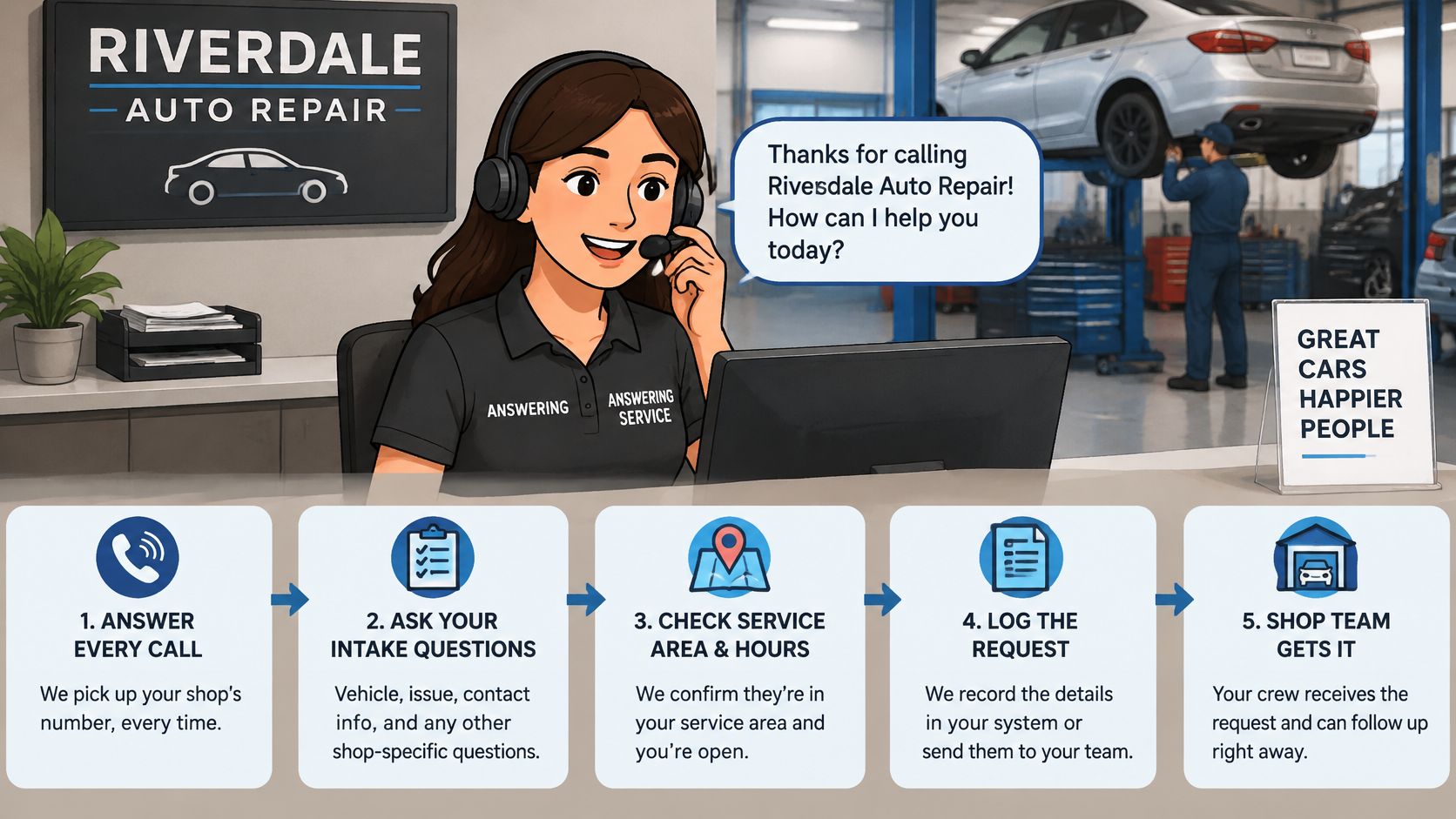
What the layer covers, at minimum:
- First-ring answering, every hour. Holidays, snow days, and the twenty minutes when the whole team is standing at the parts counter.
- English and Spanish without a handoff. A caller switches language mid-sentence and the call keeps moving.
- A written record. Each call produces a transcript and a short summary, so an advisor can see what the customer was told before the car arrives.
The background work is unglamorous and it decides everything. During setup, the shop writes down its hours, its service list, prices and policies, what counts as an emergency, which numbers get a transfer, the answers to the ten questions the front desk hears daily, and the calendar that bookings write into. Skip that step and you get a generic script back.
What the service cannot do matters just as much. It doesn't diagnose a noise, authorize a repair, or quote a price the shop never gave it. Anything outside the rulebook becomes a callback request, not a guess.
Before comparing providers, pull last week's call log. Count how many calls rang out, how many hit voicemail, and how many landed after closing. Then write down the questions your front desk asks every single time. That list is your intake spec, and it's the only thing separating a useful answering layer from an expensive message pad. The volume justifies the effort: CDK Global's survey of more than 2,500 service customers found that 64% of service customers preferred scheduling by phone, compared with 19% who preferred online. When dealerships put AI on service calls, WardsAuto's report on Pied Piper's study found 91% of those calls handled without employee intervention, appointment requests included. The Marek Automotive case study shows what that looks like on a real rush morning.
Sort Warning Signs Before You Book
The first question on an auto repair call is never "when would you like to bring it in." It's "is the car safe to drive right now." The slot, the estimate and the parts check all wait until that gets answered.
The symptoms that stop a booking cold are specific. A soft or sinking brake pedal. Pulling while braking. Squealing or grinding brakes. Overheating or steam from under the hood. Smoke or a burning odor. Difficulty starting. Steering vibration that shouldn't be there belongs on the same list: a shaking wheel or wandering steering can point to a failing wheel or steering component, so it gets treated as a safety check before any slot is offered. The AAA warning-sign guide lists these among the problems drivers should never ignore, and it draws a line worth teaching every receptionist: a flashing check-engine light is more serious than a steady one, because it can indicate a condition that causes immediate damage, and the driver should stop driving rather than push on.
The three follow-ups that decide the route
Once safety is settled, the next questions come in a fixed order:
- What does the driver see, hear or smell? A grinding noise from one corner and a burning smell from the same corner are different problems with different urgency.
- When did it start? Ten minutes ago on the highway reads differently than three weeks and slowly getting worse.
- Does it happen once or keep repeating? A single warning light that cleared is a diagnostic; a light that returns every time the car warms up is a same-day job.
Those answers separate a routine diagnostic slot from a same-day visit or a tow. The table below is the version to print and tape inside the front desk.
| Caller symptom | Safe to drive? | Route | Next question |
|---|---|---|---|
| Soft or sinking brake pedal | No, do not drive | Safety escalation | Did it come on suddenly? |
| Pulling while braking | No, do not drive | Safety escalation | Which side pulls? |
| Brakes squealing or grinding | No, do not drive | Safety escalation | Is the noise constant or only when braking? |
| Overheating or steam from the engine | No, pull over | Safety escalation | Did the temperature gauge rise first? |
| Smoke or burning odor | No, pull over | Safety escalation | Where does the smoke or smell come from? |
| Flashing check-engine light | No, avoid driving | Safety escalation | Has the light been steady before? |
| Difficulty starting or no start | Not driving | Same-day diagnostic or tow | Clicking, cranking or nothing? |
| Abnormal steering vibration | Do not drive until inspected | Same-day safety review | Does it happen at speed? |
| Steady check-engine light with no other symptoms | Generally drivable, book soon | Standard diagnostic slot | Any change in performance? |
| Oil change or inspection | Yes | Routine booking | Mileage and last service date |
Answer the safety question before anything else is offered, work the follow-ups in order, and never place a car that shouldn't be driven into a standard appointment slot two days out.
A caller with a soft brake pedal doesn't need your next opening. They need to stop driving and hear what happens next.
Capture Vehicle Details Before Booking
A booking is only as good as the details behind it. Take the fields in the order the call gives them to you, and each one removes a specific way the appointment can go wrong.
Year, make and model, first and always. This tells you whether the shop services the brand at all, and it tells the parts counter what to plan for. Without it, you're holding a slot for a car nobody has checked.
Engine or drivetrain type, next. Diesels, hybrids and any brand your techs don't work on need to be identified before the slot is taken. A bay that can't handle the job books a wasted morning, and the customer finds out when they're standing at the counter.
The symptom in the driver's own words. "It makes a noise" is a starting point. "It grinds from the front right when I brake" is a diagnosis queue. Write down what they say, not your interpretation of it.
What they see, hear or smell, and when it started. These two details set urgency and job length, and they give the technician a hypothesis before the hood comes up.
Estimated job length. A noise check and a no-start diagnosis block out very different amounts of time. Guess short and the schedule collapses by 10 a.m.
Drop-off or arrival time, plus a callback number. The shop needs to know when to have the bay clear and the advisor ready.
| Field | Why the shop needs it | Example answer |
|---|---|---|
| Year, make and model | Confirms the shop services the brand and plans parts and tools | 2019 Honda Civic |
| Engine or drivetrain type | Diesel, hybrid or unsupported brands need checking before the slot is taken | Hybrid |
| Symptom in the driver's words | Gives the technician a starting point for diagnosis | Pulls left under braking |
| What the driver sees, hears or smells | Separates a routine diagnosis from urgent work | Grinding from front right |
| When it started | Shows whether the problem is new or getting worse | Since Tuesday, after rain |
| Estimated job length | Blocks enough time for diagnosis or repair | About one hour |
| Drop-off or arrival time | Lets the shop prepare the bay and technician | Tomorrow, 7:30 a.m. |
A finished intake reads like this: a 2019 sedan pulling left under braking, grinding from the front right since Tuesday, drop-off tomorrow at 7:30. That's a booking a shop can work with.
Sarah answers every call in English and Spanish and asks the business's exact intake questions, then checks service area and budget before booking the matching slot into an open calendar. Our booking and intake setup is where those fields and rules get defined. The rule to hold onto: if a required field is missing, hold the booking until it's filled in. A guess costs more than a callback.
How to Route Tow-Ins, Emergencies and Maintenance
Three kinds of calls reach a shop, and each one needs its own road. Treat them all as appointments and the urgent one sits behind the oil change.
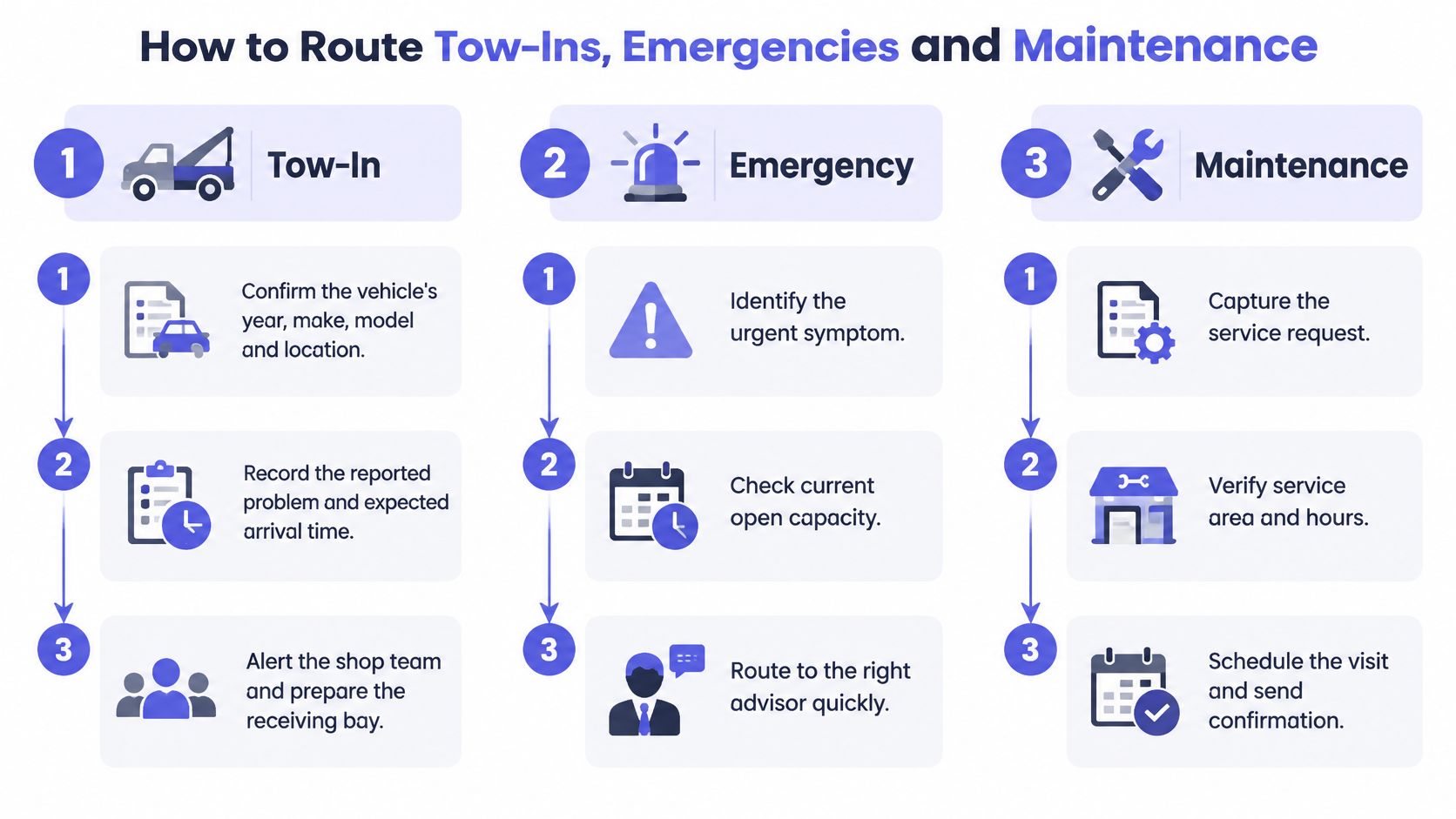
Path 1, the tow-in
- Confirm year, make, model and where the car is right now.
- Record the reported problem and the expected arrival time.
- Alert the owner or lead tech before the truck pulls in, so a receiving spot and a bay are clear.
A tow-in is a coordination event, not a scheduling one. Nothing on that call should be promised to the driver except that the shop knows the car is coming.
Path 2, the safety issue
- Classify the call as unsafe, using the warning signs, not the caller's mood.
- Tell the driver to pull over and get roadside help when the symptom is dangerous. AAA's guide to warning lights recommends pulling over and seeking assistance for a flashing check-engine light, overheating, smoke or similar symptoms.
- Escalate to the owner's mobile under the shop's emergency rules.
- If the owner can't be reached, take a callback request, write down the question, and tell the driver exactly what happens next.
Path 3, routine maintenance
- Confirm the job is standard, like an oil change or a state inspection.
- Find the next open slot that fits the expected time in the bay.
- Send a booking confirmation by text or email so the customer has it in writing.
The paths stay separate for one reason: a shared queue delays the urgent call behind the routine one. A tow-in needs coordination, an emergency needs escalation, and a maintenance visit needs scheduling. Mixing them means the smoking car waits while somebody reads out an oil change slot.
The service also has a hard boundary. When it doesn't know an answer, it doesn't invent one. It takes a callback request, writes the question down, and sends it to the business by text or email, so the customer hears the answer from the person who owns it. That's part of how the platform handles escalations and notifications alongside calendar bookings.
Print these three paths and post them where the front desk can see them. If the person answering has to think about which path a call takes, the path isn't written clearly enough.
Hand Off From the Call to Text Follow-Up
A driver calls at 7:40 a.m. about a brake warning light. The call gets triaged, the visit gets booked, and then the shop has to keep that customer informed for two days without tying up the phone line again. That second half runs on text.
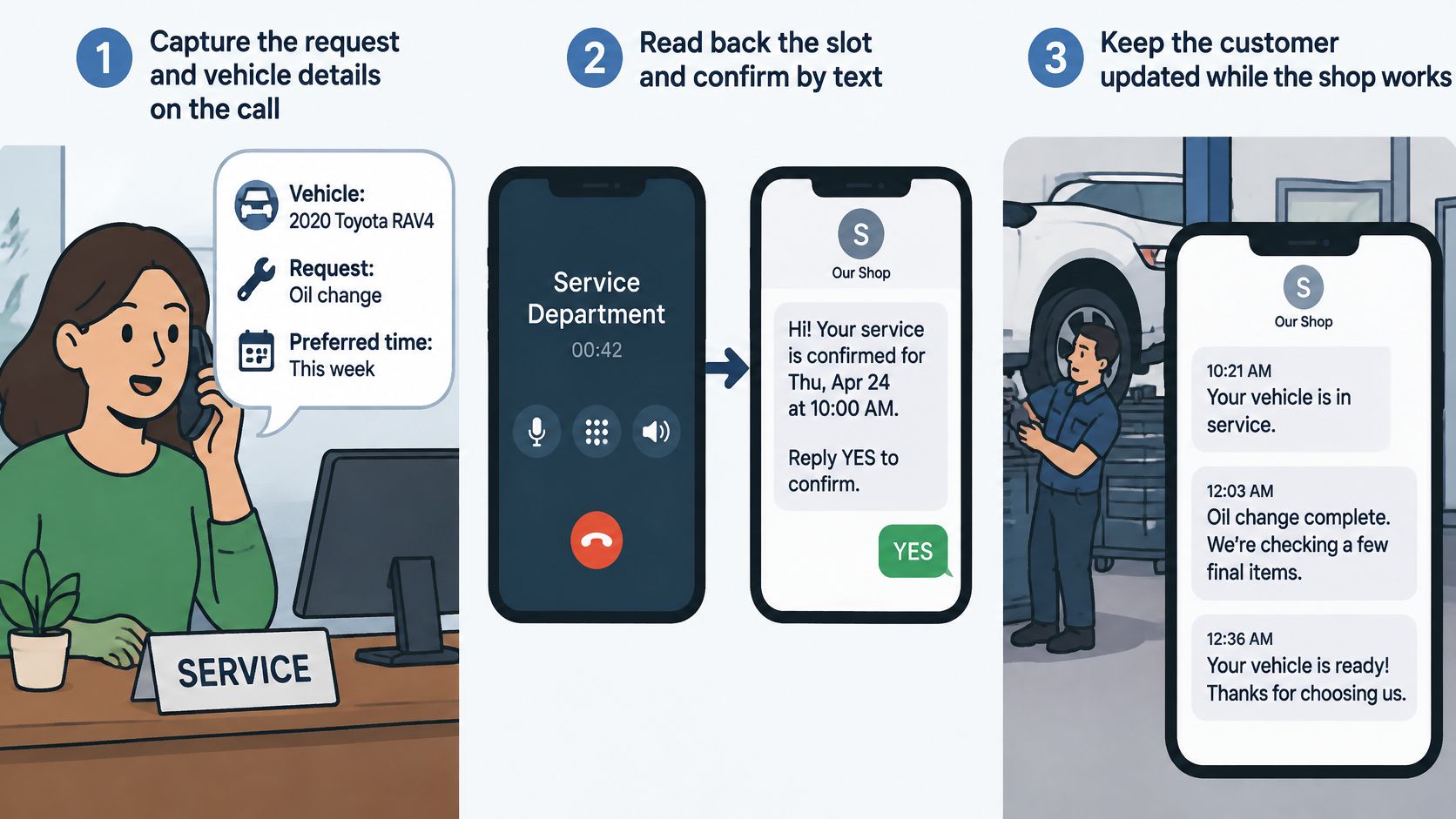
The sequence worth building runs in four steps:
- Capture the request and the vehicle details on the call.
- Read the slot back and confirm the drop-off time out loud.
- Send the confirmation through the shop's scheduling system or CRM.
- Follow with status updates and a pickup alert once the car is ready.
Customers want that split. J.D. Power research cited in AutoZone's customer communication guide found that 56% of tire-replacement and quick-lube customers preferred text-message work updates, with some still receiving phone calls instead. Voice takes the intent, text carries the follow-through.
Here's the line to hold. A booked visit is not consent for work. Confirmation means the customer agreed to a time and a symptom inspection. Authorization for anything beyond the agreed scope, especially a safety-critical repair, needs documented customer approval before a wrench moves. A voice agent can schedule a visit. It should never imply it approved a repair.
There's a practical limit on the phone side too. In message mode, the service answers questions and records the caller's details and request, but it doesn't book, change or cancel appointments. Text follow-up only works while booking is active, so know which mode your line is running in before you promise a confirmed slot.
Each call also produces a written transcript and a short summary in the dashboard. That's the record an advisor checks before the customer arrives: what they were told, what they described, and what they agreed to.
Run one test this week. Pick a recent booked call, pull the transcript, check that the confirmation text matches the slot, and confirm the advisor has an approval record on file. If any of those three fails, the handoff is broken somewhere.
Text is for convenience and a paper trail. Approval for a repair still happens between a person and a customer.
What Missed Calls Cost in a Rush-Hour Shop
At 7:30 a.m. the bays fill, the coffee is still hot, and every technician is already under a car. That is when the phone rings hardest. Use a plainly illustrative example: if 31 calls come in during the first freeze Monday and 19 turn into booked visits, that is $9,900 of pending work at about $521 a ticket, while roughly one in four comparable callers used to reach voicemail.
| Measure | Worked example | How it is calculated |
|---|---|---|
| Calls answered in the 7:30 a.m. rush | 31 | Example call count |
| Vehicles booked | 19 | Example booked count |
| Booking rate | 61% | 19 divided by 31 calls |
| Work value booked | $9,900 | Example sum of booked estimates |
| Average value per booked vehicle | About $521 | $9,900 divided by 19 |
| Calls that reached voicemail before coverage | About one in four | Example prior share |
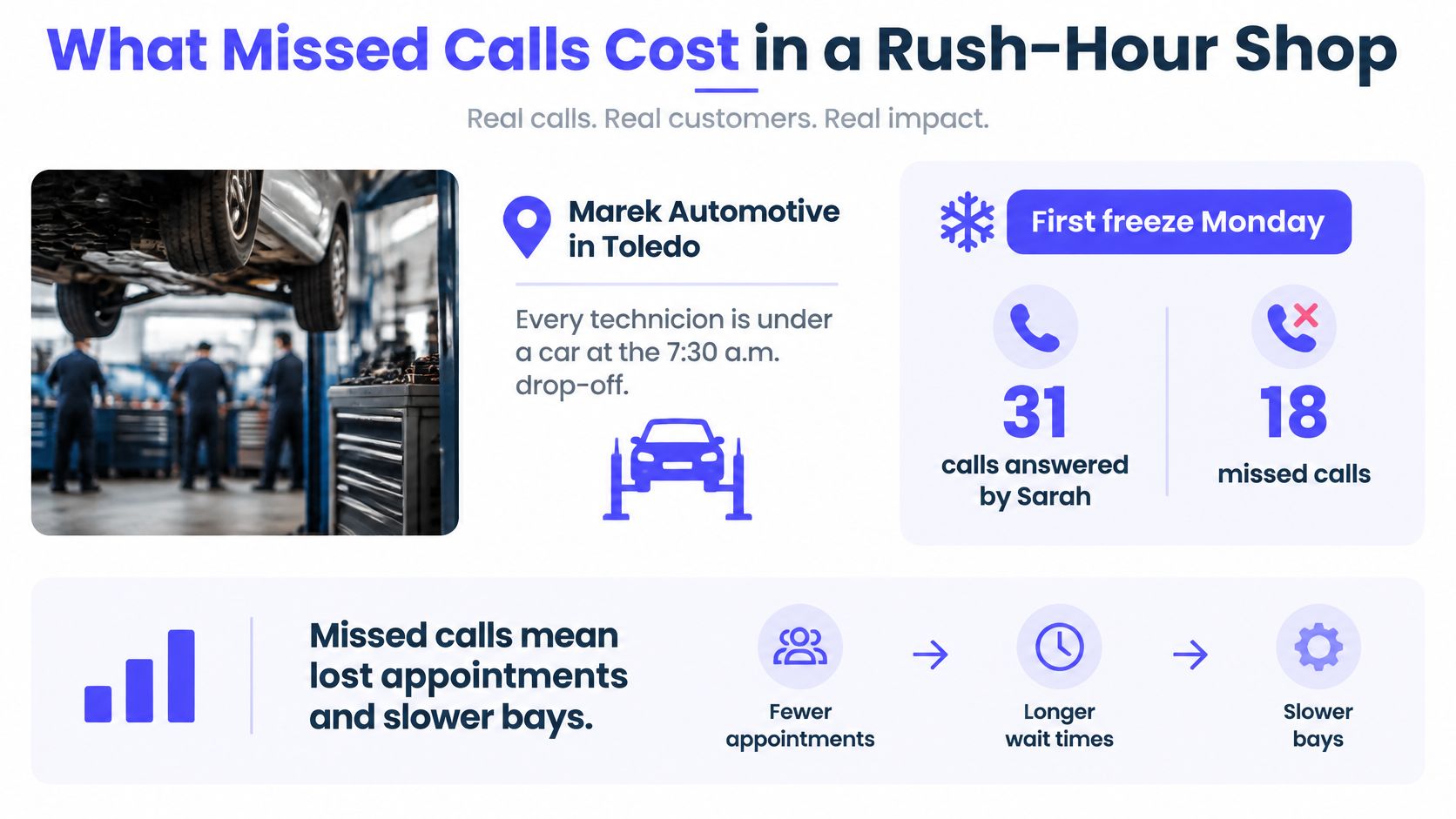
Read that table as a measuring pattern, not a promise. The point is the shape of the loss: when the queue is longest, every ring is still a triage decision. Voicemail cannot separate smoke, overheating, abnormal braking or a flashing check-engine light from an oil change, so the urgent call and the easy booking leak together. A driver with those symptoms may need roadside help rather than an appointment, and AAA's list of common car problems shows why those calls cannot sit behind routine chatter.
For wider context, Kimoby's analysis of dealership call data cites Car Wars data covering nearly 3,000 dealerships in which only about 65% of callers connected with a person, and Marchex missed or failed automotive service-call rates of up to 21%. Dealerships are not independent bays, but the pattern carries over: callers who do not reach a person rarely wait politely.
Track five numbers every month: calls answered, booking rate, calls that reached voicemail, booked work value, and average value per booked vehicle. Answer rate shows coverage. Booking rate shows whether triage turns conversations into slots. Voicemail count shows the leak. Work value and average ticket show whether the phone is feeding profitable hours or only filling the calendar.
Ansa has answered over 2 million calls for local businesses, so this loss pattern is familiar across service lines. If you want the arithmetic before you pull the phone log, the missed-call calculator runs the same five measures; treat the output as a starting estimate and compare it with what got booked.
Choose a Plan That Fits Your Call Volume
Match the plan to the call volume, not to the feature list. Count after-hours calls and missed calls in a typical month, then pick the tier that manages them without buying capacity you won't use.
| Plan | Monthly price | Call allowance | Booking and extras |
|---|---|---|---|
| Lite | $49 | 250 minutes | Google Calendar booking, lead texts |
| Self-serve | $297 | Unlimited | Calendar or CRM booking, confirmation texts, emergencies to owner, Recovered Revenue Dashboard |
| Done-for-you | $497 | Unlimited | Team-managed setup, voice configuration, weekly improvements, priority support |
| Enterprise | Custom | Unlimited | Several locations, one setup per location, custom integrations |
The terms are worth reading plainly. Billing is month to month with no setup or per-seat fees, every plan carries a 14-day money-back guarantee, and cancellation runs through the dashboard with no sales call, retention offer or questionnaire attached. Ansa's Lite plan answers every call 24/7, handles FAQs, takes every detail, books into Google Calendar and texts the owner each lead; after the 250 minutes it keeps answering but takes messages rather than completing bookings until the month resets, which suits a low-volume shop. Self-serve adds unlimited calls, calendar or CRM booking, confirmation texts to callers, emergencies put through to the owner and the Recovered Revenue Dashboard. Done-for-you is $497 a month, built for one business, and covers a team-managed setup that takes about five minutes of the owner's input.
Then run the numbers against missed calls. At the $521 average booked value in the Toledo record, one recovered booking covers a month of Self-serve at $297, and two cover Done-for-you, provided your own average job value sits in a similar range. If your average ticket is smaller, work the math with your number, not theirs.
Here's the path I'd take this week:
- Count after-hours and missed calls over the past month.
- Match that volume to a plan tier.
- Request the free demo by entering your phone number, and Sarah calls back within a minute or two, answering as your business.
- Test the five highest-risk calls from the triage table before you go live. A brake complaint, a tow-in, an overheating call, a no-start and a plain oil change will tell you more than any feature list.
Your shop's phone line is already making triage decisions every day, just not always the right ones. Ansa answers every call to your business line, day or night, in English or Spanish, asks your intake questions, checks service area and open capacity, and books into an available slot instead of leaving a message. Start with the demo: enter your number, hear Sarah handle a brake complaint and a tow-in as your shop, then decide. Visit Ansa to run that test call while last month's call log is still in front of you.
Enhanced by the Outrank tool