A Congressional Research Service summary counted 4.2 billion robocalls to U.S. phones in April 2026, about 13 calls per person, nearly 140 million a day, roughly 1,600 every second (Congressional Research Service). That's the environment your customers live in. Their habit of ignoring a number they don't recognize wasn't built out of rudeness. It was built by that volume.
Which means an unanswered call is never just an accident. It's a decision made twice, once by the person deciding whether to pick up and once by the business deciding who is allowed to answer on its behalf. Both decisions carry risk. Answer everything and your staff spends the day on spinners, wrong numbers and someone reading a script about your extended warranty. Answer nothing and the roof leak goes to the next roofer on the map.
Most advice about missed calls falls apart here. It treats answer rate as the score to maximize, when the key question is which calls a business can afford to lose. The consumer rule to "don't answer the phone" is rational. The business problem is staying reachable without asking customers to abandon a habit that protects them.
Table of Contents
- Which Unanswered Calls Cost You the Most
- Why Real Customers Stop Answering Unknown Numbers
- Why Answering Every Call Is Not Always Better
- How to Screen Calls Without Turning Away Customers
- Ways to Keep Phone Coverage Compared
- What Callers Do After Voicemail
- Set Your Call Rule Before the Next Missed Call
Which Unanswered Calls Cost You the Most
Not every missed call carries the same price tag. A missed emergency costs a job and probably the referral that would have followed it. A missed solicitor costs the eight seconds someone spent listening to a recorded pitch. Treat both as one "lost call" and your call report tells you nothing you can act on.
The channel has widened enormously. Pew Research Center's tracking shows cellphone ownership reached 98% of U.S. adults by June 2025, with smartphone ownership at 91%, up from 35% at the Center's first measurement in 2011 (Pew Research Center). Those who call a plumber, roofer, or law firm now typically dial from a device in their hand, often while standing in the problem they want fixed.
Pew measures ownership, not conversion. Nothing in that tracking proves a missed call becomes lost revenue, and anyone who tells you otherwise is overselling the data. The sorting has to come from your own log.
| Caller situation | Likely next move if unanswered | Right response |
|---|---|---|
| Emergency repair, such as a burst pipe or no heat | Calls another business straight away | Live answer or immediate escalation to the owner |
| Estimate or quote request | Tries the next company in search results | Booking or callback the same day |
| Routine appointment | Leaves a message or switches to online chat | Automated booking with text confirmation |
| Existing customer rescheduling | Calls back later or leaves a complaint | Quick callback within the business day |
| Solicitation or wrong number | Nothing lost | Screen out without staff time |
Two rows carry almost all of the money. An emergency caller has already decided to spend, and a search results page hands them four alternatives before they finish dialing. An estimate request behaves the same way with slightly more patience. Routine bookings can wait an hour. Existing customers can usually wait a day, though the goodwill cost of a slow callback is real and shows up in reviews rather than invoices.
The bottom row deserves attention too, because it's where staff time goes to die. Solicitations and wrong numbers need no courtesy call back, and the faster they leave the queue, the more attention the top rows get.
The test you can run this week
Pull last week's unanswered calls and sort each one into those five rows. Most phone systems produce the list in a few clicks even when the reasons aren't labeled. If emergencies and estimates make up a large share, the coverage gap is expensive and worth fixing this month rather than next quarter.
Practical rule: A missed call is only a loss if the person on the other end had work for you. Grade the queue by the work, not by the ring.
If the top two rows are nearly empty and the bottom row is crowded, you don't have a missed-call problem. You have a screening problem, and that changes what you buy. To size the exposure before choosing anything, the missed call calculator converts missed-call volume into an hourly figure.
Why Real Customers Stop Answering Unknown Numbers
The number on the screen decides pickup. Whatever your greeting, your hold time or your Google rating, a call from a line nobody recognizes starts at a structural disadvantage.
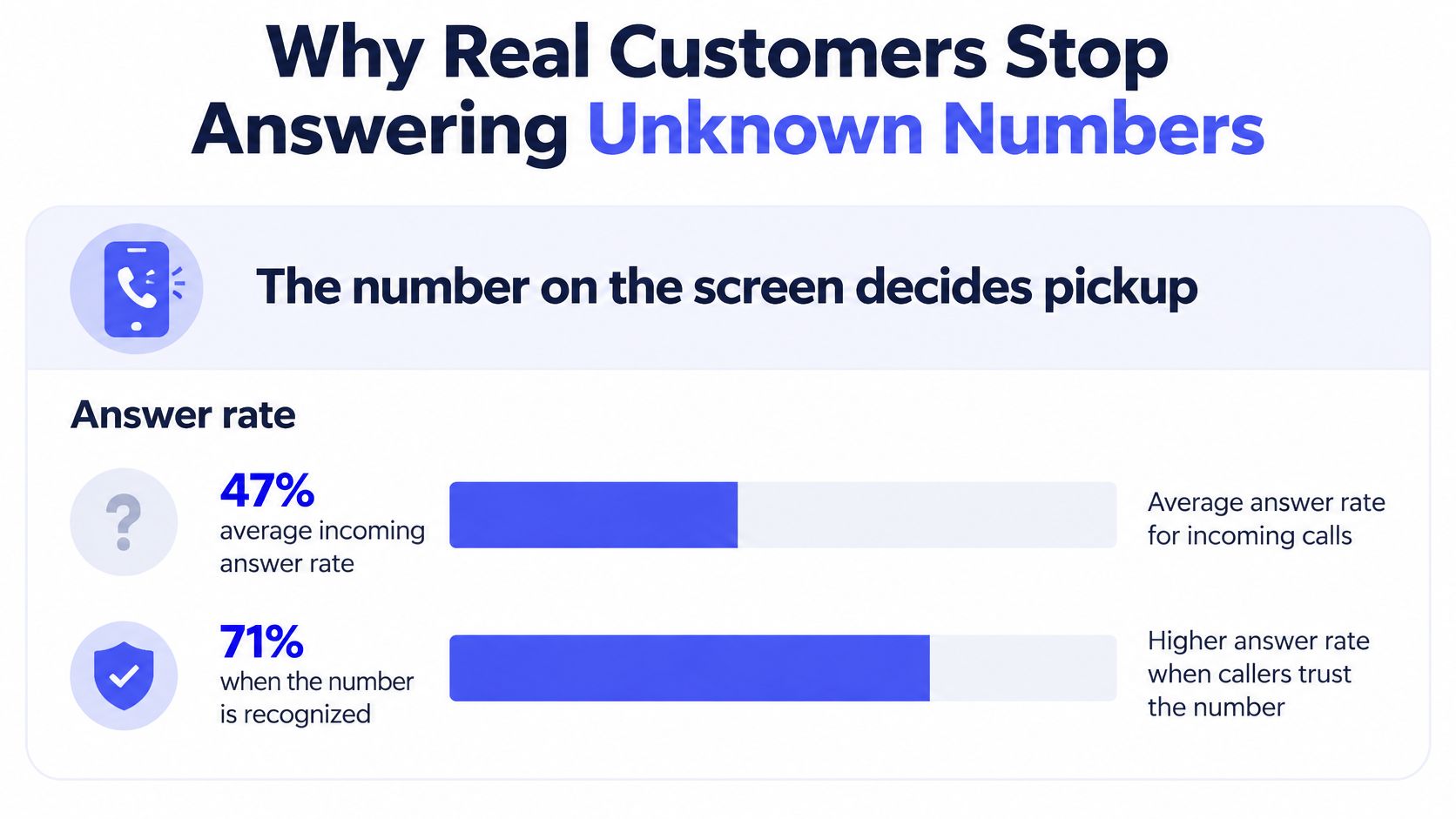
Federal Communications Commission-cited Hiya data puts the average incoming-call answer rate at 47%, and the spread by caller identification is the most actionable set of numbers in this subject (FCC).
| Caller identification | Answer rate |
|---|---|
| Average incoming call | 47% |
| Number saved in contacts | 71% |
| Number identified as business | 65% |
| Unidentified number | 18% |
| Number labeled spam | 9% |
The distance between 71% and 18% is the whole story. Same customer, same need, same moment. Only the label on the screen changed.
What moves the number
Three settings sit inside your control, and each one buys back answer rate.
One outbound number for everything. Estimates, callbacks, invoices, review requests. People save numbers they see repeatedly, and the saved-contact row is the best-performing line in that table.
The business name wherever carriers support it. A verified business label puts a call in the 65% row instead of the 18% row. Register the brand with your carrier or the caller-ID service your phone provider works with rather than assuming it happens automatically.
No bursts from unfamiliar lines. Twenty calls in ten minutes from a number nobody has seen trips spam analytics. Pace outbound campaigns, and don't rent a fresh number for every technician.
The alternative to winning the callback is skipping it. An inbound call answered at the moment of intent doesn't depend on anyone trusting a screen, which is why handling the first call beats being fast on the return.
Callback rule: If you must dial back an unknown number, send a text from the business name first. It costs one message and turns a 9% call into a recognizable one.
Why Answering Every Call Is Not Always Better
The premise that every unanswered call is a loss collapses once you look at who's calling. Spam robocalls in the United States averaged 2.56 billion per month from January through September 2025, up from 2.14 billion a month in 2024 and the highest level in six years (PIRG). Pew data cited in that reporting puts roughly one-third of adults receiving at least one scam call a day, and about one quarter have handed over personal information after a scam call, text or email.
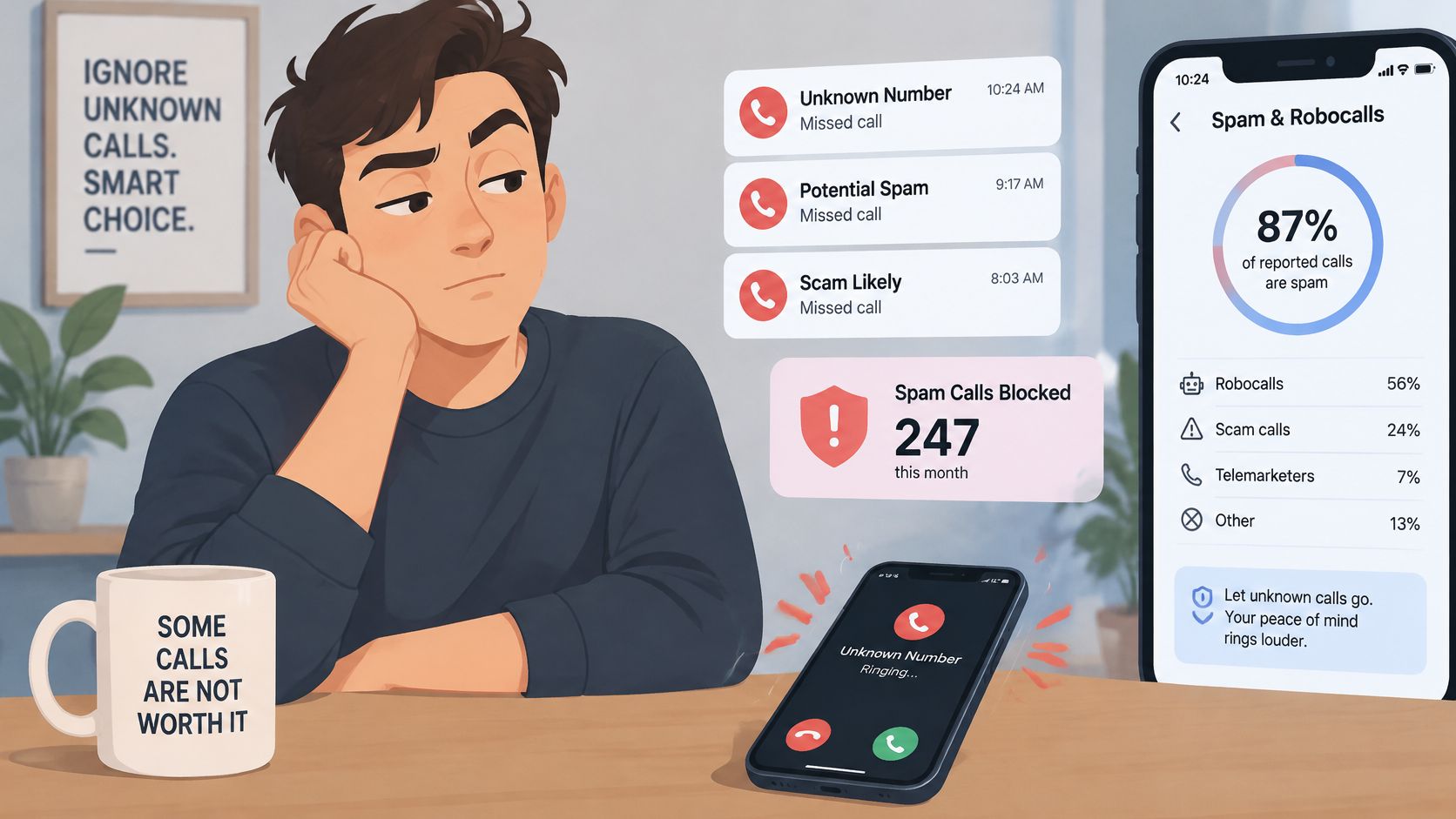
That changes the arithmetic of answering. Someone who picks up every call becomes a confirmed live target and gets more of them. Someone who picks up none loses the plumber. Both behaviors are learned, and customers learn them from the calls they receive, not from your business.
So the goal isn't a higher answer rate. It's a higher qualified answer rate, and those are different targets. A setup that answers everything but exposes customers to fraud, screens out real callers by accident or trains people to distrust the number will post a beautiful answer rate while the business gets worse. Screening isn't the same act as answering, and it's the rules, not the pickup decision, that need the scrutiny.
The boundary that can't move: Urgent calls still have to reach a person, and they have to do it without loosening the checks around money and account access.
Replace answer rate with measures that survive contact with reality.
Booked jobs per call. Count the outcome, not the pickup.
False positives. Real customers your rules turned away. Sample the transcripts monthly, because this number hides.
Complaints about calls. People who felt interrogated, cut off or pushed to a website.
Share of urgent calls that reached a person. It should be close to all of them.
Here's how the mechanics look in practice, including where screening ends and a person takes over.
How to Screen Calls Without Turning Away Customers
Screening fails in two directions. Too loose and staff drown. Too strict and a homeowner with a burst pipe gets treated like a robocall. This routine holds both ends.
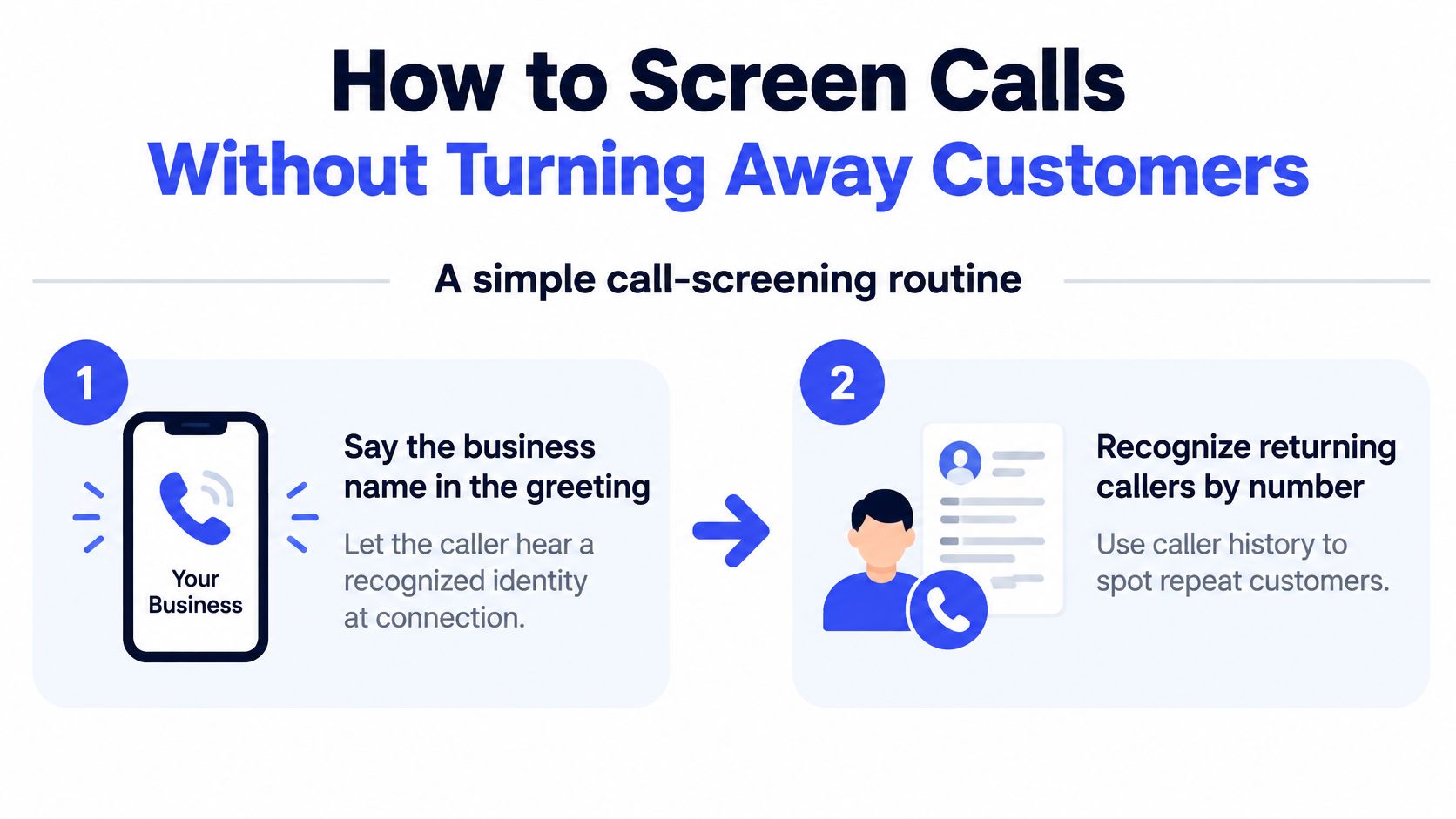
Say the business name in the greeting. The first three seconds should tell the caller they reached a company, not a call center. A generic "hello, how can I help" makes people hang up, because it sounds exactly like the calls they're avoiding.
Recognize returning callers by number. If the number is already in your calendar or CRM, skip the questions they've answered before and confirm what's changed. The slip here is asking an existing customer for their address a fourth time, which reads as a business that doesn't remember them.
Check the service area and service type before offering a time. Callers whose address falls outside the area shouldn't get a booking; say plainly that the address is outside the area and take a message instead. The common slip is an area check so tight it rejects the next town over, where you'd happily drive.
Route rule-matched urgent calls to a person. When a call matches an escalation rule, don't book it. Take the caller's details and pass them to the owner. A blocked drain on a Sunday shouldn't land on Tuesday because the calendar happened to have a slot.
Verify before acting on money or account access. If a caller wants to change payment details or dispute an invoice, ask them to ring back on the number you already hold. Legitimate customers accept that without complaint. People running a scam rarely do.
Collect only what the job needs. Name, callback number, address, problem. Never passwords, full card numbers or ID numbers over the phone, no matter who claims to be calling.
Run a test call before any rule goes live. Ask the question a real customer would ask and listen for where the flow turns into an interrogation. Owners who test their own rules catch more in five minutes than they do in a month of transcripts.
Two habits make the routine hold. First, write the escalation rules down and name the person they reach, because a rule with no owner gets ignored. Second, review the turned-away calls weekly for the first month. The addresses that got declined and the services that got messaged are your best evidence of where the logic is too sharp.
What a working screen looks like is boring and specific. Real customers reach a person or a calendar slot. Spam stops consuming staff time. Nobody is asked for a card number to confirm an appointment. When intake ends in a booking, the booking and intake setup matters more than the greeting, because an appointment in the wrong slot creates more work than a clean message ever does.
Ways to Keep Phone Coverage Compared
Five options, and none is free in the sense that matters. Each trades money for hours, or hours for interruptions.
| Coverage option | Hours covered | Books appointments | Handles urgent calls | Main trade-off |
|---|---|---|---|---|
| Staff answer in person | Business hours only | Yes, if staff can see the calendar | Only when someone is free | Interruptions to billable work |
| Voicemail with manual callback | Around the clock, reply delayed | After callback | Slowly, if at all | Many callers do not leave a message |
| Forward to owner's mobile | When the owner can answer | Manually | Yes, if the owner picks up | Owner is pulled off jobs |
| Answering service | Set hours or around the clock | Usually takes messages | Relays to owner | Limited knowledge of your services |
| AI receptionist | Around the clock | Yes, with calendar connection | Yes, escalates by rule | Needs setup and rule upkeep |
Staff answering in person wins on warmth and loses on focus. Every call is a technician, an estimator or an office manager stopping mid-task, and that cost never shows up on a phone bill. Voicemail looks free and usually is, in the sense that few people use it. Forwarding to the owner keeps coverage during a drive between jobs and then turns a Saturday into a workday.
An answering service buys coverage and a script someone else wrote. Expect messages rather than confirmed slots unless you've trained the service on your calendar and your prices. An AI receptionist covers the same hours with direct booking and rule-based escalation, and the trade-off is administrative: somebody has to keep the service list, the service area and the emergency rules current.
How forwarding actually works
You don't port the number. The business forwards missed calls from its existing line to the receptionist's number using a short code or the phone's built-in call-forwarding settings, and callers keep dialing the number they already know. You can send every call or only the calls you miss, which decides whether staff keep first contact on the busy hours. Turning forwarding off returns the phone to ringing exactly as it did before, which makes this one of the few coverage changes you can trial for a week and reverse on a Friday.
Choose by mix, not by preference. If urgent calls are frequent and your staff are often on jobs, favor the setup that escalates to a person. If routine bookings dominate, favor the one that books directly. The coverage options comparison is worth reading against your own call list rather than in the abstract.
What Callers Do After Voicemail
A voicemail greeting feels like a safety net. It isn't one. In a 2025 survey of 1,000 U.S. consumers, 24% of callers who could not reach a business switched to online chat and 21% called another business immediately, while only 42% left a voicemail (Beside). Nearly half of unreachable callers either change channel or defect on the first attempt. Read the figures as a floor rather than a ceiling: the survey captures the first move after a missed call, not whether anyone tried again later.
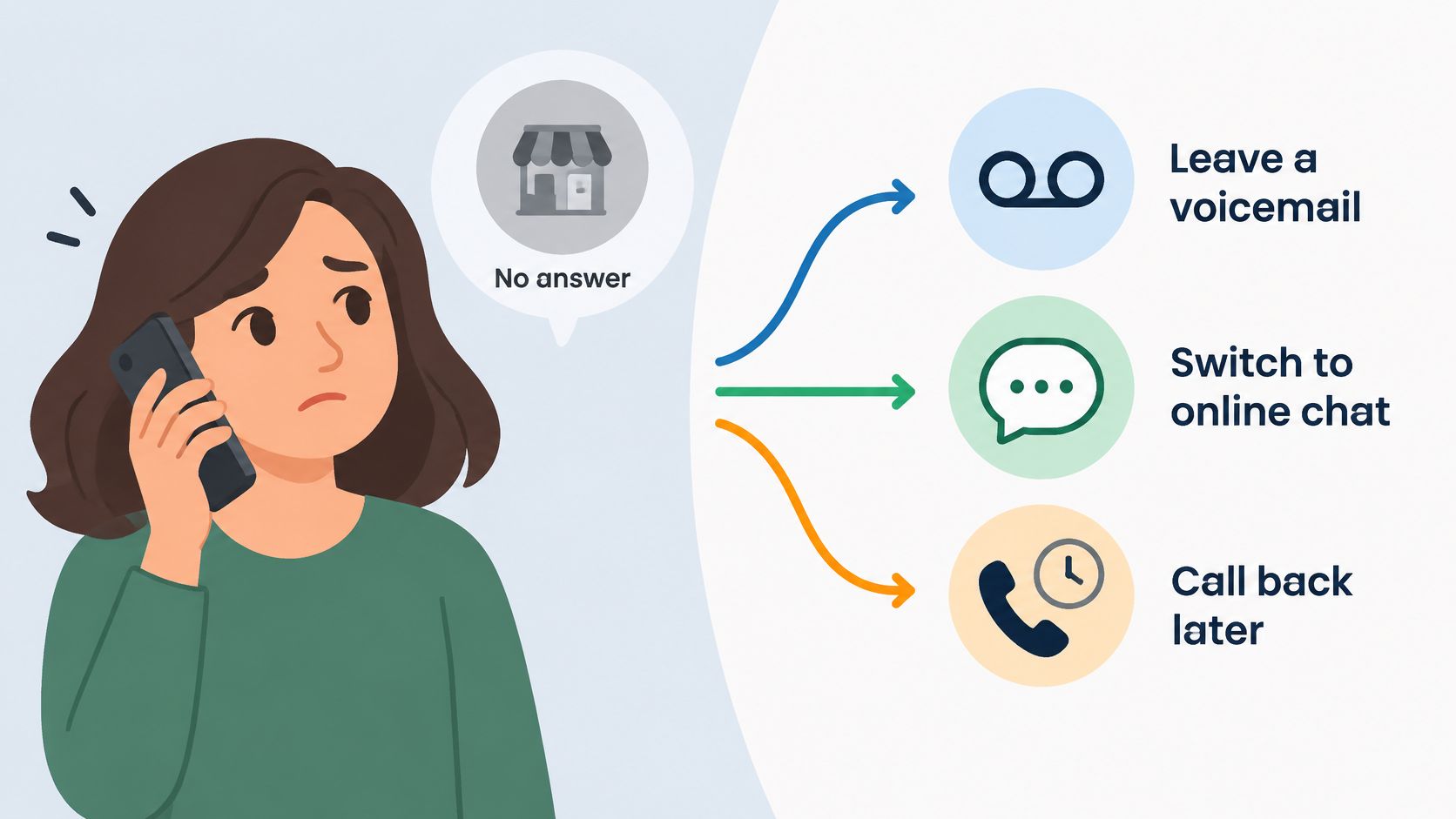
Follow one caller. Burst pipe at seven in the evening, phone rings out, a friendly greeting picks up. On the survey's numbers, the odds that caller leaves a message are under even, and the caller who does leave one is the minority case. The greeting didn't fail. It just wasn't a recovery plan.
Three recovery paths, by urgency
Emergency service needs a live human or an escalation that reaches a person within minutes. Anything slower is a callback to a customer who already found someone else.
Estimate requests and vague questions don't need a person instantly. They need a low-friction follow-up, which means a text with a booking link or a two-field web form. The failure mode is requiring a phone call to arrange a phone call.
Routine appointments should book themselves when the request is on your service list. Anything off the list becomes a message, never a guess, and the same holds for a question with no prepared answer. The correct move is a callback request with the question written down, sent to the owner by text or email, rather than an improvised policy the business then has to honor.
Capture beats triage when the flood hits. A team too busy to answer one listing had fifty calls come in during that stretch, and the automated receptionist caught all fifty for follow-up instead of letting them ring into silence.
Measure recovery, not volume
Answer rate alone is a weak scoreboard here. Track recovered jobs and time to first response, because a voicemail queue worked through hours later converts worse than the same calls answered live. By the time the callback happens, the caller has often already booked elsewhere.
Consent language belongs on the form that collects the number, and an opt-out line belongs in every automated text, because follow-up that annoys people costs more than the lead is worth.
Two more details do quiet damage. If a meaningful share of your market speaks Spanish, the follow-up has to match the language the caller started in. And deduplicate on phone number, or one customer calling three times about the same leak becomes three tickets and two callbacks.
Set Your Call Rule Before the Next Missed Call
Decide now, in writing, so the next missed call isn't handled by whoever happens to be free.
The rule: Escalate emergencies to a person. Book routine appointments automatically when the request is on your list. Send a text follow-up for estimates and anything unclear.
Test it before customers hear it. Run a test call and ask the question a customer would ask, then check the rule against last week's unanswered calls sorted into the five situations from earlier. If emergencies are landing in a booking flow, tighten the escalation. If estimates are ending in a message, loosen it.
The quickest way to hear how the rule behaves is a free demo where you enter a phone number and Sarah calls back answering as your business, and you listen live before deciding. Sarah answers the business line day or night in English or Spanish, which covers the out-of-hours window where most of these calls land. On Lite, after 250 minutes she keeps answering every call but takes messages until the next billing period, with no overage charge, so a heavy month doesn't produce a surprise invoice.
Then make the decision itself. Pick the coverage option that handles your urgent calls, and if routine bookings dominate your log, pick the one that books directly. That choice is cheaper to make today than after another season of callbacks to people who already hired someone.
Ansa answers the business line around the clock, screens out solicitations and wrong numbers, books routine appointments into your calendar and passes urgent calls to you with the caller's details attached. If you're weighing whether to answer every call or none of them, run the middle path for a week and compare the log. Start at Ansa and forward only the calls you miss.