
A call in script is the word-for-word set of lines a business uses to answer inbound calls. A working one has five stages: the greeting, three qualification questions, a price answer, a cleanup of stock phrases, and a booking close that confirms the details. The first sentence decides whether the caller stays on the line.
Most inbound scripts waste the opening. They open with a menu, a recorded apology, or a promise that the call matters, and by then the caller has already decided the business is hard to reach. Phone is still the first-choice service channel for a large share of customers, so a weak opening costs real bookings.
Each stage starts by answering the caller's problem instead of introducing your process. The lines below are word for word. Copy them, swap in your own details, cut the stock phrases listed in stage four, and run a test call before a customer hears the new version.
Table of Contents
- 1. Opening greeting with business name, speaker, and offer to help
- 2. Three qualification questions near the top of the call
- 3. A price-shopper response with a real range and the next open time
- 4. Which menus and stock phrases should you delete before callers hear them?
- 5. The booking close and confirmation that stops repeat calls
- How each call in script template fits into the call
- Turn these lines into a test call before your next busy day
1. Opening greeting with business name, speaker, and offer to help
The first sentence of an inbound call has three jobs. It confirms the caller reached the right business, says who is speaking, and offers help. Call-centre guidance recommends introducing both the business and the person answering as early as possible, then inviting the caller to explain the reason for the call, according to Call Centre Helper's guide to good call handling.

Three lines that cover almost every inbound call
"Thanks for calling Apex Roofing, this is Sarah, the AI assistant. How can I help you?"
"Thanks for calling [Business Name], this is [Name]. What can I help you with today?"
"[Business Name], this is [Name]. Are you calling about a repair, an estimate, or something urgent?"
The first line is the one to copy for most service businesses. Naming the assistant openly sets expectations, so the caller can describe a problem, book a visit, or ask for a person without feeling tricked four questions later. The third line earns its place when volume is high and the call needs triaging in one breath, though it does push the caller toward your categories rather than their own words.
Use the name the caller actually searched for
Say a homeowner searches for roof repair, taps a listing for Apex Roofing, and dials. If the greeting says Apex Property Solutions, the caller pauses and asks whether they reached the right company. That pause is where bookings leak, so use the trading name from your listing, your sign, and your invoice.
Voice has been a business channel for more than a century. U.S. Census and FCC historical tables record 17,424,400 telephones by 1932, up from approximately 47,900 in 1880, and 38.045 million telephones in 1950, of which 11.775 million were business lines (1952 Statistical Abstract of the United States). The greeting is where that channel still begins.
Time it. A greeting that runs past five seconds has turned into a recording.
Name the AI when it is one. Honesty here buys patience later in the call.
Ask one open question. Two questions in the opening invite the caller to answer only the last one.
The line works because it answers the caller's real question first, which is whether they reached the right place and whether anyone will help.
2. Three qualification questions near the top of the call
Three questions, asked in the right order, decide whether a call becomes a booked job or five minutes of detail you can't use. Home-service call guidance puts the sequence plainly: find out what the job is and whether it's urgent, get the service address to confirm coverage, then take the best contact details for the confirmation (Hatch's inbound call script guide).
Urgent problems drive a lot of inbound calls. A 2025 survey cited by Attainment's answered-call gap report found 74% of consumers preferred calling for complex or urgent problems, against 56% for general issues. That's the traffic your second question is sorting.
Here's the sequence worked through on a live call.
The three lines, in the order that works
Problem and urgency. "What's going on with the roof, and is it urgent, like an active leak?"
Address. "What's the address for the job, so I can confirm we cover your area?"
Name and number. "What's the best name and number to reach you at about this?"
Let the caller describe the problem in their own words before the urgency question lands. "It's dripping into the hallway light" tells you more than any bucket of options, and it tells you whether the call jumps the queue.
Why the address question needs a stated reason
Give the reason out loud. A caller who hears "so I can confirm we cover your area" hands over the address without suspicion, and the same question with no context sounds like a form being filled in. Confirm the callback number back digit by digit, because a transposed digit is the most expensive typo at a front desk.
The pattern travels across trades. An automotive answering service script asks what the vehicle is doing, where it's parked, and the best number for the job, and the routing logic is identical.
Set the emergency rule first. Write two or three conditions before launch, such as an active leak, no heat in freezing weather, or a burning smell at an outlet. Anything that matches goes straight to the owner's phone and skips the booking calendar.
3. A price-shopper response with a real range and the next open time
Answer the price question in the first sentence. Then offer a time.
Price shoppers hang up on deflections, and a number followed by a slot gives them a reason to stay. Lead qualification guidance for service businesses, such as Praktivo's advice on qualifying inbound callers, treats pricing and scheduling as one conversation. Once the job and location are clear, the script should move toward a workable slot. Pressure is the wrong tool here. The caller keeps the decision, and a concrete opening is easier to say yes to than a vague promise to have someone call back.
"A drain cleaning usually runs between X and Y. I have tomorrow at 10 open. Do you want it?"
That line does three things in about eight seconds. It answers the question the caller rang to ask. It turns the next step into a yes-or-no instead of an open search. And it leaves the choice where it belongs. Replace X and Y with your real range and keep the second sentence to a single slot.

What to say when the price depends on the visit
"Our standard inspection is X dollars. The next opening is Thursday at 2. Should I book that?"
The flat fee becomes the anchor, and the closing question needs nothing more than a yes. Use this version when one number covers the visit itself.
"For a repair like this, the range is usually X to Y, and the estimate visit is free. I can hold Friday at 9 for you."
This line has the same shape with a wider range: a number, then a slot, then a question. The free estimate carries the weight when the job itself can't be priced blind.
If the figure depends on what's on site, say so in one sentence and pivot to the estimate. Inventing a range to keep a caller talking wins the booking and loses the job. Load your real ranges and visit fees into the answering system's dashboard before launch, or hand them to whoever reads the script. The line is only as honest as the numbers behind it.
Keep the delivery flat
Skip countdown language. "I can only hold this until noon" reads as a tactic and pushes callers off the phone.
Offer one slot. One time plus a fallback is easy to say yes to, and a list of times makes the caller do the work. If the first slot fails, offer one more, then stop.
Take the no. "No problem. Want me to text you the range so you have it?" keeps the door open without pressure.
4. Which menus and stock phrases should you delete before callers hear them?
Delete the three worst openers before callers hear them, because each one can cost you the call the moment it plays. They are "Your call is important to us," a numbered menu, and "please listen carefully as our options have changed," which tells the caller your system changed and their time didn't matter.
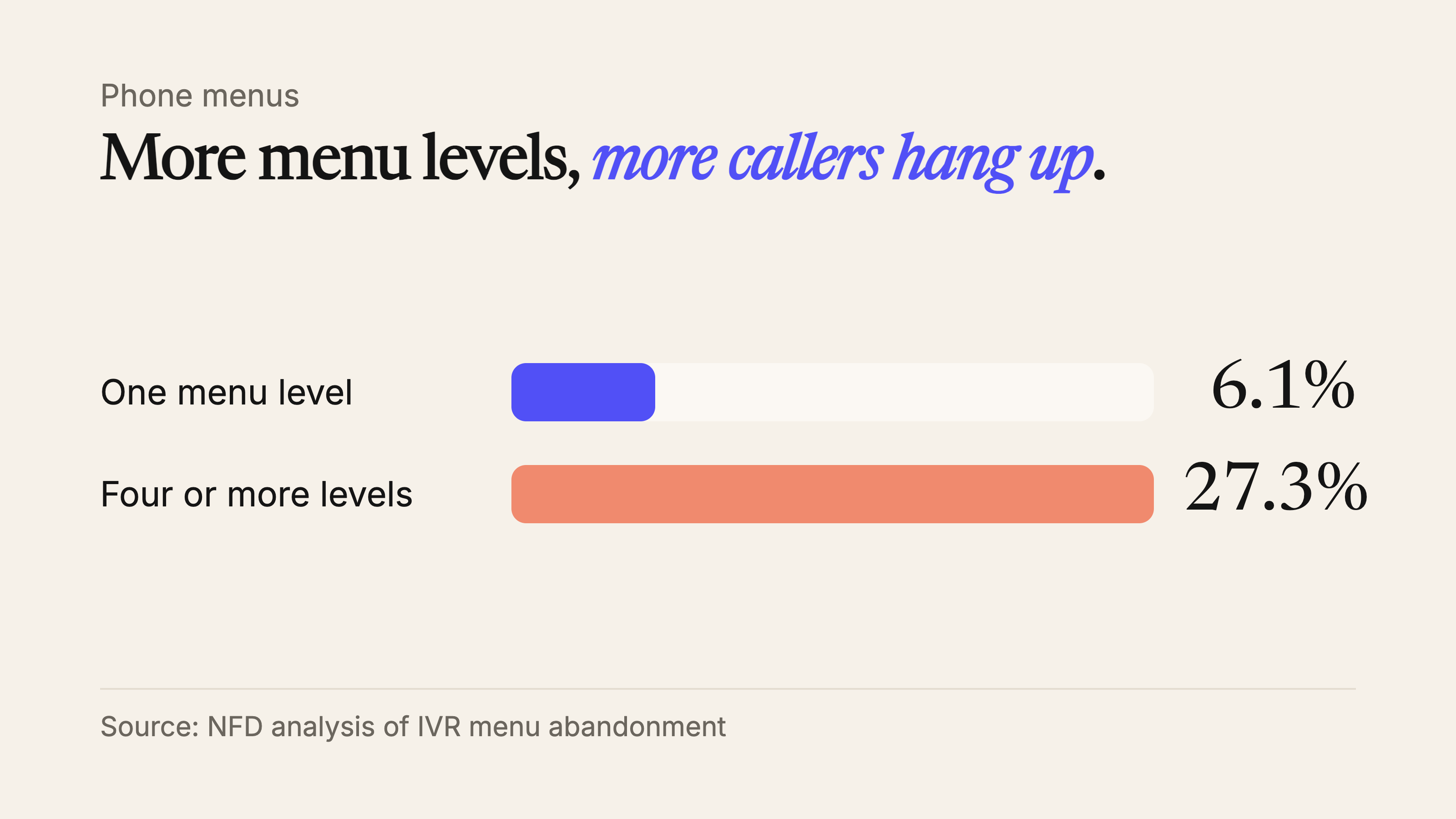
Menu depth is measurable. An analysis of IVR menu abandonment found abandonment of approximately 6.1% for a single-level menu, rising to 27.3% when callers faced four or more menu levels. The same analysis gives 30% to 60% as a typical containment range for IVR systems, depending on call mix. Every extra level is another chance to lose the caller before a person or a well-built assistant hears the problem.
The three replacements
For "Your call is important to us." "Thanks for calling. What can I help you with?"
For a long menu. "Are you calling about a repair, an estimate, or a scheduled visit?"
For "Please listen carefully as our options have changed." "Tell me a bit about what's going on."
Each replacement does the same job in one sentence. It hands the conversation to the caller instead of to your phone tree, and it gives them a reason to keep talking.
A worked example
Say a plumbing company takes a dozen calls before 9 a.m. and opens with a four-option menu. Callers who press the wrong option get transferred, callers who reach voicemail dial the next plumber, and the dispatcher spends the first hour sorting calls that could have sorted themselves. Swap the menu for one open question with three branches (emergency, booking, general question) and those same calls need far less of that hour.
Read the script out loud once
Read it aloud and cut every sentence that doesn't help the caller. Read it again looking only for phrases you've heard on hold music, because filler is easier to spot in your own line than in anyone else's. A sentence that could play before any business name in the country is filler, so cut it.
Callers want their problem answered in the first sentence.
5. The booking close and confirmation that stops repeat calls
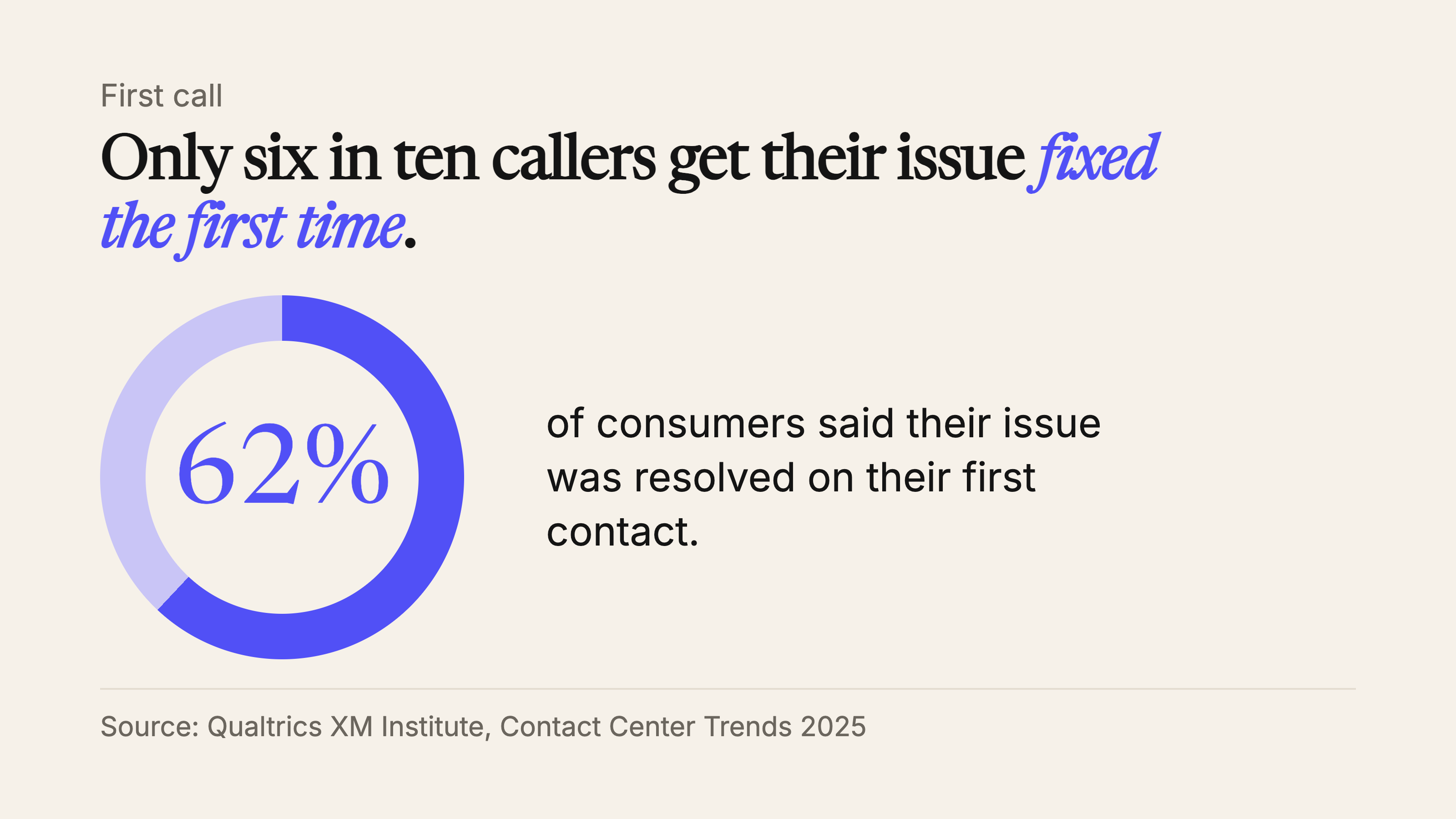
A call that ends without a confirmed detail becomes tomorrow's repeat call, and repeat calls are what make a phone line feel busy all day. Qualtrics' 2025 global contact-center research found that only 62% of consumers reported having their issue resolved during their first contact, while overall contact-center satisfaction remained at 63% (Qualtrics contact-center trends report). The close is where your business lands on the right side of that gap.
"You're booked for Thursday at 2 at [Address]. You'll get a text confirmation shortly. Is there anything else I can help with?"
Two other closes that hold up: "I have you down for an estimate on Friday at 9, with a callback at [Number]. Anything else before I let you go?" and "We're set for tomorrow at 10 for the drain cleaning. You'll get a text with the details." Note what each one contains: the day, the time, the job, the address or number, and the next thing that happens.
Read the details back instead of repeating them
Speech recognition and human note-taking fail in the same place, on unusual names and fast numbers. A 2025 STAMMA survey of 356 people who stammer found phone interactions across sectors failing to anticipate their needs. The organisation estimates at least 550,000 adults in the UK stammer, corresponding to roughly 43 million calls annually (STAMMA's 2025 report on phone accessibility). Build the close for that caller and it works for everyone: leave a beat before asking for a name, spell it back, and send the details in writing so nobody relies on memory.
Make the confirmation match the calendar
Read it back, then check the entry. The confirmed details and the calendar entry have to match before the call ends, whether a person typed it or Sarah booked it. See how bookings land in your calendar or CRM.
Send the confirmation. A text with the day, time, and address removes an entire category of "I thought it was Tuesday" calls.
Offer rescheduling at the close. "If that slot gets tight, call and we'll move it" costs nothing and saves a no-show.
How each call in script template fits into the call
| Item | Call Stage | Main Goal | Common Pitfall |
|---|---|---|---|
| Opening Greeting: Business Name, Speaker, and Offer to Help | Call opening | Confirm the business, identify the speaker, and invite the caller to explain their need | Generic or overly long greeting |
| Three Core Qualification Questions Near the Top of the Call | Early call qualification | Identify the issue and urgency, check service area, and collect contact details | Asking too many questions before the caller feels heard |
| Price-Shopper Objection Response: Real Range Plus Next Open Time | Pricing and booking | Give an accurate price or range and offer a specific appointment time | Quoting inaccurate prices or pricing work that requires an estimate |
| Phrases and Menus to Remove Because They Sound Robotic | Call opening and routing | Replace filler and long menus with direct, conversational responses | Removing menus may complicate routing for complex businesses |
| Booking Close and Confirmation Script | Call close | Confirm appointment details and explain what happens next | Repetitive read-backs or no written confirmation |
Turn these lines into a test call before your next busy day
Pick one call in script template, adapt the bracketed details to your services and prices, and read the full call aloud before it goes live. Then call your own line and behave like the worst-behaved customer you've had this month.
Ask a price question mid-sentence and see where the answer lands. Mumble an address and check whether it comes back correctly. Interrupt in the middle of the qualification questions, ask something out of scope, then go quiet for four seconds to see whether the script waits or steamrolls you. A script that survives those three minutes is ready for a Friday afternoon.
The phone still matters to the people who pay you. In a 2024 survey of 1,556 U.S. consumers published by TransUnion, 78% said phone calls were important for communicating with businesses, despite the widespread reluctance to answer them (TransUnion newsroom). A testing habit costs an hour; a season of calls that reached voicemail costs a lot more.
Keep the scoreboard small, too. Track booked calls, repeat calls, and calls that ended without a next step, and read the transcripts of your ten worst calls each week. Patterns show up fast in writing that stay invisible in the middle of a busy day.
If you want to hear how this works before changing your own line, the free demo lets you enter a phone number and listen as Sarah calls back and answers as the business.
Ansa runs Sarah, an AI receptionist who answers inbound calls for local service businesses, follows the qualification order above, and writes appointments straight into your calendar or CRM. Confirmation texts go out when the call ends. Every plan answers in English and Spanish, and a text or email alert reaches you the moment a job is booked. Visit Ansa to see the plans or to hear Sarah on a call of your own.