An answering service is a business that answers phone calls for other companies, following each company's rules to take messages, transfer urgent calls, and book appointments. For service owners, it replaces an unanswered ring with a direct response that captures the lead right away.
Many plumbers, roofers, electricians, and attorneys still treat voicemail as a reliable safety net. Most callers expect an immediate answer, and many dial the next number on their list when a greeting tells them to leave a message. That gap leaves paid jobs sitting in an inbox while the owner finishes work on a job site or sits in court.
A well-configured answering setup changes three daily outcomes for a business owner. Fewer jobs disappear into voicemail, routine appointments get booked during the call, and true emergencies reach the owner while standard inquiries wait neatly in the queue.
Table of Contents
- What is an answering service?
- How a call moves through an answering service
- Live operators versus AI receptionists
- Which businesses use answering services and for what
- Limits and risks to check before you sign up
- Decide whether an answering service fits your business
What is an answering service?
An answering service is a commercial operation that picks up incoming telephone calls on behalf of another organization and follows that business's specific instructions. The operator or automated system greets the caller in the company's name, answers basic questions, screens urgent requests, and captures lead information or schedules a job.
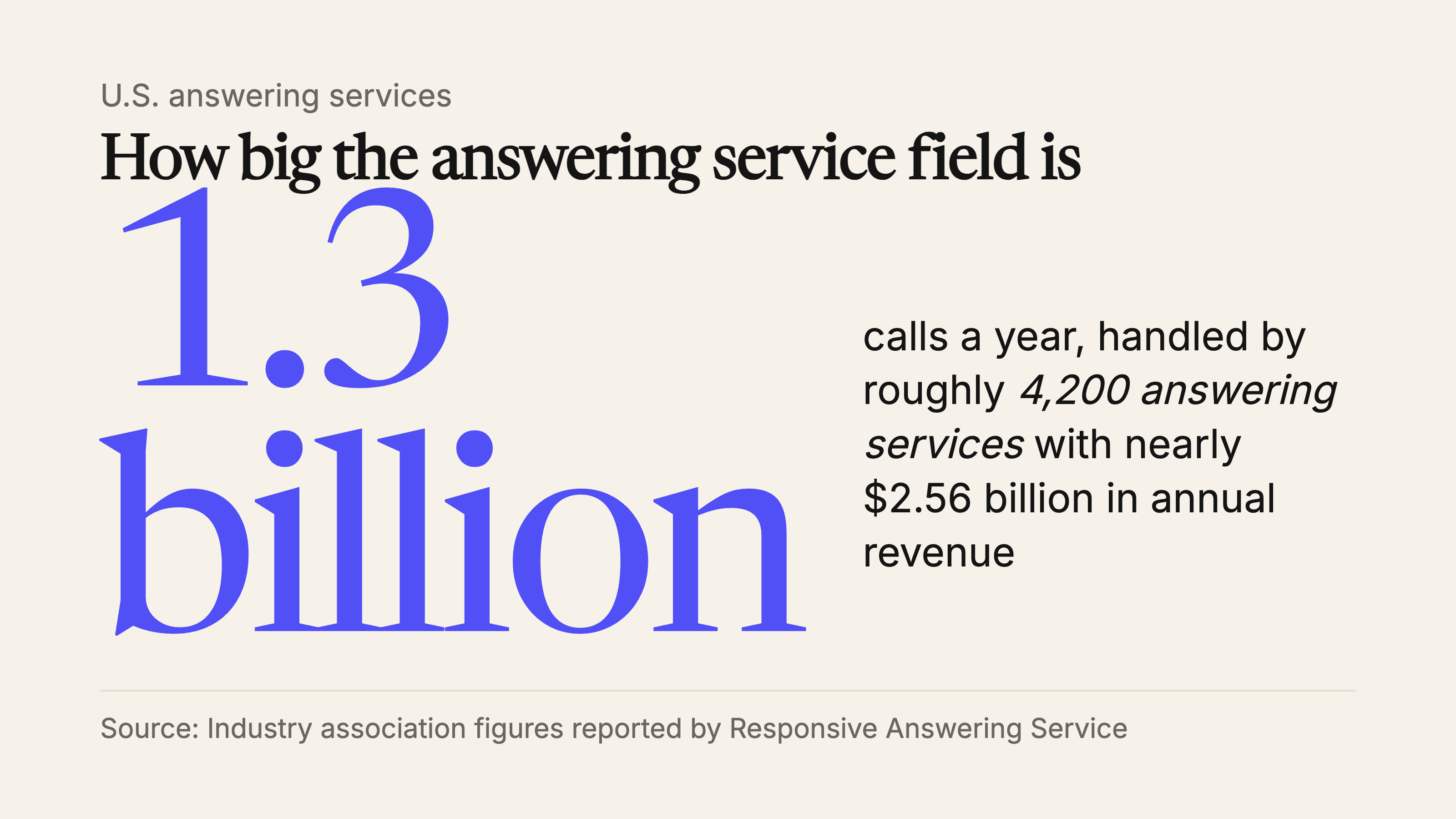
According to Call Center Advisor, the modern dictionary definition of an answering service dates to 1952, growing out of manual telephone bureaus where operators answered calls in each client's name. The field operates at significant scale across the United States. Industry association figures reported by Responsive Answering Service put the U.S. market at roughly 4,200 answering services handling about 1.3 billion calls each year, representing nearly $2.56 billion in annual revenue.
How modern call handling differs from voicemail
A live person or automated voice system talks with the caller and acts on the request immediately, while voicemail stores a passive recording that may sit unheard for hours. Today's providers deliver that coverage in three main ways: a live human operator, an AI receptionist, or a hybrid setup combining both.
Owner's phone test: Look at what happens the next time your business phone rings while you're under a sink, on a roof, or with a client. Trace who picks up, what the caller hears, and whether that caller leaves with a confirmed time slot.
Every feature a provider sells matters only when it moves three numbers for the owner. Those outcomes are fewer jobs lost to voicemail, more appointments booked during the first call, and urgent emergencies reaching the owner fast while routine calls wait.
How a call moves through an answering service
Incoming calls reach the answering service through call forwarding on your existing business phone line. You set the line to forward when nobody picks up after a chosen number of rings, or whenever the line is busy. You keep your exact phone number, and callers notice zero change when they dial.
The visual below shows the core flow from the first ring to the written summary sent to the business.

Eight steps from ring to follow-up
- The call forwards automatically. A customer dials your published business number. When your phone rings unanswered or shows busy, the carrier routes the call straight to the service.
- The service delivers your greeting. The operator or voice system answers using your exact business name, so the caller knows they reached the right company.
- Intent gets identified early. The service asks why the person is calling, separating a new estimate request from a billing question or a burst pipe.
- Contact and job details get recorded and verified. The service collects the caller's name, callback number, street address, and your custom intake questions. Good workflows read those details back aloud because a single wrong digit or street number wastes a truck roll.
- Service area and job scope get checked. The system compares the caller's ZIP code and requested task against your approved list. For example, with Ansa's AI receptionist Sarah, if a caller asks for a service outside your services list, Sarah takes a message and leaves the calendar open for you to review.
- Routine jobs land on the calendar. When the request matches your rules and an open slot exists, the service books the appointment directly into your calendar or logs a complete message for follow-up.
- Urgent situations trigger immediate alerts. Calls matching your emergency rules bypass the routine queue and transfer or send an instant alert to your mobile phone.
- Summaries arrive right after hang-up. You receive a text or email summary along with a written transcript, while the booked caller receives a confirmation text with their scheduled time.
When forwarding works well, the caller hears your business name, gets clear answers, and hangs up with a booked time and a confirmation text. They have every detail they need and zero reason to dial a competitor. Meanwhile, you glance at your phone between jobs and see a confirmed appointment with complete notes.
The short video below walks through how an inbound call gets screened, scheduled, and logged without interrupting your workday.
What each call type produces for the owner
Different callers need different outcomes. A solid setup maps each common scenario to a specific action so the owner knows exactly what shows up on their phone.
| Call type | What the service does | What the owner gets |
|---|---|---|
| Routine booking during business hours | Books an open slot in the calendar | Confirmed appointment and a text to the owner |
| Booking request after hours | Answers, collects details, and books or takes a message | Booking or message with a transcript |
| Emergency, such as a burst pipe | Transfers or alerts the owner's phone | Immediate alert to the owner |
| Service not on the list | Takes a message with the caller's details | Message to review later |
| Returning caller | Finds the caller by phone number and skips repeat questions | Faster booking with existing details |
Every row ends with two clear wins. The caller gets a concrete next step on the spot, and the owner receives a structured record ready for dispatch or review.
Live operators versus AI receptionists
A live operator is a trained human agent who answers incoming calls remotely using a script supplied by your company. An AI receptionist is voice software trained on your services, pricing rules, and calendar that holds a spoken conversation with callers. Both answer the same ringing phone, so the difference shows up in how each one behaves once the caller starts talking.
Follow one difficult call through each model. A homeowner phones at 6 p.m. convinced a contractor overcharged her, and the script has no entry for disputes. A skilled human reads her tone, calms her down, and uses judgment on a problem the rulebook never anticipated. That flexibility makes live receptionists a strong match for sensitive legal intake or complex customer disputes.
Now follow a different kind of pressure: volume. Staffed call centers face physical limits around shift scheduling and call queues, so when several customers call during a storm or lunch rush, each caller waits for the next free agent. A RingCentral contact-center report cites an average hold time of 58.3 seconds and reports that 13.2% of customers drop out before resolution. Every dropped caller is a homeowner dialing the next name on Google.
How an AI receptionist handles volume and schedules
Software answers multiple lines at once, which removes shift gaps and hold queues entirely. Ansa, for example, answers calls 24/7, including holidays, and picks up on the first ring so callers never reach voicemail.
When the same homeowner phones an AI receptionist with an unusual complaint, the behavior depends on what the software knows. Sarah, Ansa's receptionist, never makes up an answer. When she does not know one, she takes a callback request, writes down the question, and sends it to the owner by text or email. The caller still leaves with a next step, but judgment on the unusual problem stays with you.
Owners should also pay close attention to which operating mode they turn on. In message mode, the service answers common questions and records the caller's details and request, while appointment booking, rescheduling, and cancellations stay turned off. Full calendar booking requires connecting the software to a scheduling tool such as Google Calendar, Jobber, or Housecall Pro.
Caller comfort with automated scheduling has grown steadily. A CallRail survey of 1,000 U.S. consumers cited by Goodfellas Tech found that 50% of respondents would use AI to book an appointment.
Live operator and AI receptionist compared
Weigh both models side by side against your daily call volume using the criteria below.
| Criteria | Live operator | AI receptionist |
|---|---|---|
| Hours covered | Set shifts or agreed service hours | Around the clock, including holidays |
| Answers on the first ring | Determined by staffed shift coverage and active call queue | Yes, when configured to answer every ring |
| Languages | Determined by the languages spoken by staffed agents | Set by the provider (Ansa covers English and Spanish on every plan) |
| Unexpected questions | Handled with human judgment | Answered from business rules, or logged as a callback request when unsure |
| Calendar booking | Often typed into a shared calendar | Direct booking into synced calendars such as Google Calendar or Jobber |
| Cost model | Per-call, per-minute, or monthly plan set by the provider | Monthly subscription set by the provider |
| Best fit | Calls needing human judgment and high empathy | Routine questions, calendar bookings, and after-hours coverage |
One quick test settles the choice for most owners. Pull up your phone log for the past month and sort every call into two piles: routine questions, bookings, and schedule changes in one; emotional complaints, unusual situations, and judgment calls in the other. Then compare the size of the piles.
If most incoming calls demand human judgment on emotional or unusual problems, choose a live operator. If most calls involve routine questions, calendar bookings, and after-hours coverage, an AI receptionist covers more hours for the same call load.
Which businesses use answering services and for what
Local service owners lose work whenever their hands are full and nobody sits at a front desk. In 2024, 27% of calls to home-services businesses went unanswered, according to Invoca's analysis, "See How Much Missed Sales Calls Cost Home Services Businesses," cited on Ansa's missed-call statistics page. More than one in four callers failed to reach someone when they needed a contractor.
That gap hits hard across trades where owners drive between job sites, climb ladders, or work inside mechanical rooms. The graphic below highlights five major local business types that rely on call answering to keep schedules full.

A hypothetical month for a local plumbing shop
Say a local plumbing shop receives 120 calls in a typical month. If roughly one in four goes unanswered while the owner drives or repairs a water heater, around 30 callers hit voicemail. Many of those homeowners have a leaking pipe or clogged drain right now, so they hang up and dial another plumber on Google.
Now trace that same month with call forwarding active. When the owner can't grab the phone, the call routes to the answering service on the first ring. The homeowner hears the shop's name, explains the leak, confirms their street address, and books an open afternoon window.
A confirmation text lands on the customer's phone before they set it down. If a different caller reports a burst main valve at 9 p.m., the emergency rule fires and alerts the owner's cell phone right away, while routine faucet repair requests book into tomorrow's calendar. Fewer jobs slip away to voicemail, appointments lock in during the call, and urgent work gets immediate attention.
Other local service offices that rely on call coverage
Trade contractors make up one major group, yet the same intake pattern serves any appointment-based office with limited desk staff.
- Plumbing, HVAC, electrical, and roofing companies: Capture emergency dispatch calls, schedule repair windows, and book storm or replacement estimates while crews stay on site.
- Law firms: Say a small law office gets new client calls while attorneys are in court or client meetings; the answering service runs conflict and intake questions and books a consultation time.
- Real estate teams: Answer buyer and seller inquiries from yard signs and online listings while agents host showings.
- Auto repair shops: Book oil changes, diagnostic slots, and status callbacks while mechanics stay in the service bays.
- General local service providers: Give cleaning companies, lawn care providers, and pest control teams dependable phone coverage without hiring a full-time receptionist.
Limits and risks to check before you sign up
Turning on round-the-clock phone coverage introduces real operational risks if you skip the setup checks. Always-on answering makes accuracy, routing rules, and legal compliance essential parts of your buying checklist. Ask every provider to answer the following six points in writing before you forward your main number.
1. Misheard names, addresses, and phone numbers. Telephone audio is far noisier than studio recording. Research on telephone speech recognition by the National Institute of Standards and Technology (NIST) identifies background noise, reverberation, and telephone transmission lines as core factors that degrade speech-recognition accuracy. Ask the provider in writing whether the system repeats back names, phone numbers, street addresses, and appointment slots for caller confirmation before booking a job.
2. Out-of-area or unsuitable bookings. A busy calendar fills up with wasted drives if the service books jobs outside your territory or below your minimum budget. Confirm in writing how ZIP code boundaries, service lists, and unknown questions get handled. With Sarah, when an answer sits outside the configured business info, she takes a callback request, writes down the exact question, and texts or emails the owner while never making up an answer.
3. Vague emergency routing. If your emergency rules sound loose, a noisy radiator wakes you at 2 a.m. while an active flood sits in email until morning. Ask in writing how emergency keywords are defined, which on-call phone receives the alert, and what fallback triggers if the first person misses the call.
4. Callers who want a human. Some callers feel uncomfortable speaking to automated voice software or face an unusual problem that needs a person. Confirm in writing that a clear transfer option exists so those callers can reach a live staff member or request a direct callback.
Legal consent and post-call accountability
5. Outbound callbacks, reminders, and TCPA rules. Answering an inbound call follows different legal rules than placing an outbound callback, automated reminder, or promotional follow-up. The Federal Communications Commission (FCC) confirmed that AI-generated human voices fall under the Telephone Consumer Protection Act's "artificial or prerecorded voice" rules. Outbound calls can require prior express consent, caller identification, and a working opt-out path, while telemarketing calls generally require stricter written consent. The FCC's 2024 proposal also contemplated clear disclosure when a call uses AI-generated technology. Ask your provider in writing who logs caller consent, maintains opt-out lists, and handles outbound compliance.
6. Transcripts, audit trails, and error recovery. Every system makes an occasional mistake, so quality is measured by how fast you spot and fix it. Ask in writing whether every call produces a written transcript and summary, how long records stay accessible, and how quickly the provider updates a bad script or fixes a routing error.
Written standard: Any answering provider that cannot answer these six questions clearly in writing is unready to handle your business phone line.
Decide whether an answering service fits your business
You don't need a complicated spreadsheet to evaluate call coverage. Walk through these six steps in order before signing a contract.
- Count last month's voicemails. Open your phone carrier portal or call log and total every incoming call that went unanswered over the past 30 days.
- Split daytime misses from after-hours calls. Note how many missed calls arrived while you were on active jobs versus evenings, weekends, and holidays. That split tells you whether you need overflow forwarding or full 24/7 coverage.
- Pick your exact call outcome. Decide whether you want direct calendar bookings, message-only intake, or emergency escalation alerts.
- Get pricing and scope in writing. Ask every provider for the monthly rate, minute or call allowances, calendar integrations, and cancellation terms in a written quote.
- Confirm emergency contacts and rules. Write down the three or four real emergencies in your trade and verify how each provider alerts your on-call phone.
- Test the service live. Never sign up based solely on a sales pitch. Ansa offers a free demo where you enter a phone number, Sarah calls back answering as your business, and you listen live to how the conversation flows.
What to check during a live test call
Match your live test directly against the criteria from the comparison table earlier in this guide. Listen closely for three things: your exact business name in the opening greeting, accurate intake questions that fit your real services, and the right response when you describe an emergency.
Pull one busy day from last week's call log, run a live test call using a real job request from that list, and compare the resulting booking or transcript against what your voicemail captured. That side-by-side check gives you a clear answer in five minutes.
Ansa provides an AI receptionist named Sarah that answers business calls on the first ring around the clock in English and Spanish, books jobs straight into calendars like Google Calendar, Jobber, or Housecall Pro, and routes urgent emergencies to your mobile phone. You can hear how Sarah handles your services, hours, and booking rules by testing a free live demo at Ansa.