
More roofing leads come from two moves an owner can make this month. Build a referral routine that runs after every finished job, and make the business easy to find and call when a homeowner searches for a leak or storm damage.
Everything else adds volume on top of that base, from Google Ads to purchased leads. The difference between a busy month and a slow one usually sits in the details: what you ask a happy customer, what each campaign is allowed to spend, and how fast the phone gets picked up. Each step here comes with a cost and a number so an owner can decide what to fix first.
Table of Contents
- Which lead sources bring roofing jobs fastest?
- How to build a referral system that keeps working
- How to win local search leads for your roofing business
- How to run paid search without wasting budget
- How to answer every call and book jobs during the call
- Pick one lead source to fix this week
Which lead sources bring roofing jobs fastest?
Referrals and local search bring roofing jobs fastest for the money, so those two get funded before a single ad click. The rest of the list adds reach on top of that base.
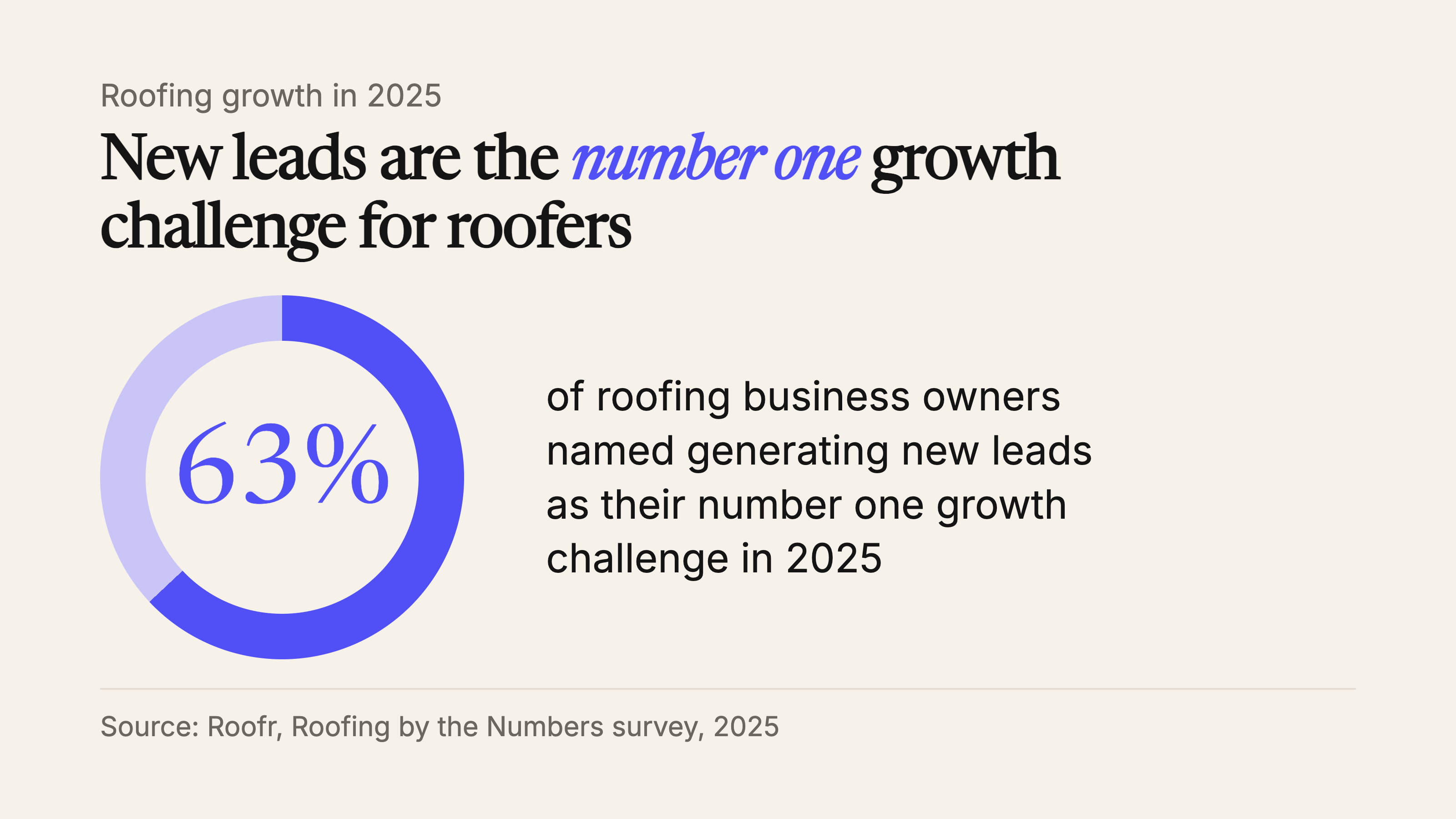
The pressure is real. 63% of roofing business owners named generating new leads as their number one growth challenge in 2025, according to Roofr's summary of the Roofing by the Numbers survey. In the same year, 95% of home-service professionals described their market as very or moderately competitive, with lead generation ranked as their top challenge in Taradel's Home Services Marketing Survey.
Homeowners follow a predictable path. Most find a roofer through word of mouth or an online search, and many go back to a contractor they have used before, according to a 2025 homeowner survey summarized in this roofing lead generation guide. Reputation and visibility carry the same demand from two directions.
The four main sources compare like this on cost, speed and control.
| Source | Typical cost per lead | Speed to first lead | What you control | Best use |
|---|---|---|---|---|
| Referrals from past customers | Low, mostly staff time | Slow to start, steady over time | Asking routine and follow-up | Trust before the first call |
| Local search (Google Business Profile and website) | No direct cost per lead, mostly your time | Medium | Listings, reviews and service pages | Homeowners researching a leak or storm damage |
| Google Search ads | About $228.15 per lead | Fast | Budget, ZIP codes and landing pages | Urgent, high-intent jobs |
| Purchased lead marketplaces | Set by the marketplace, often shared with several contractors | Fast | Lead rules and follow-up speed | Filling slow weeks |
Paid search carries the highest sticker price. Roofing Google Search leads averaged about $228.15 each in 2025, against a blended home-services average of $90.92, according to industry data compiled from LocaliQ. A marketplace inquiry can look cheaper and still cost more per booked job when the same name goes to three competitors, since the fastest callback usually wins the work.
Say a roof shop puts its whole budget into ads and never asks a finished customer for a name. Every job it wins carries the full cost of the click, and the happy neighbor who would have called for free never gets asked. One trust channel and one search channel cover both cases.
Judge each channel by booked jobs. A shared lead that reaches three contractors is worth less than a referral that reaches one. A guide to high-intent local revenue shows how local demand turns into scheduled work, and the missed-call calculator puts a price on the calls that slip through.
How to build a referral system that keeps working
A referral system is a fixed routine that runs after every finished job, with the same request, the same timing and a log that shows where each name came from.
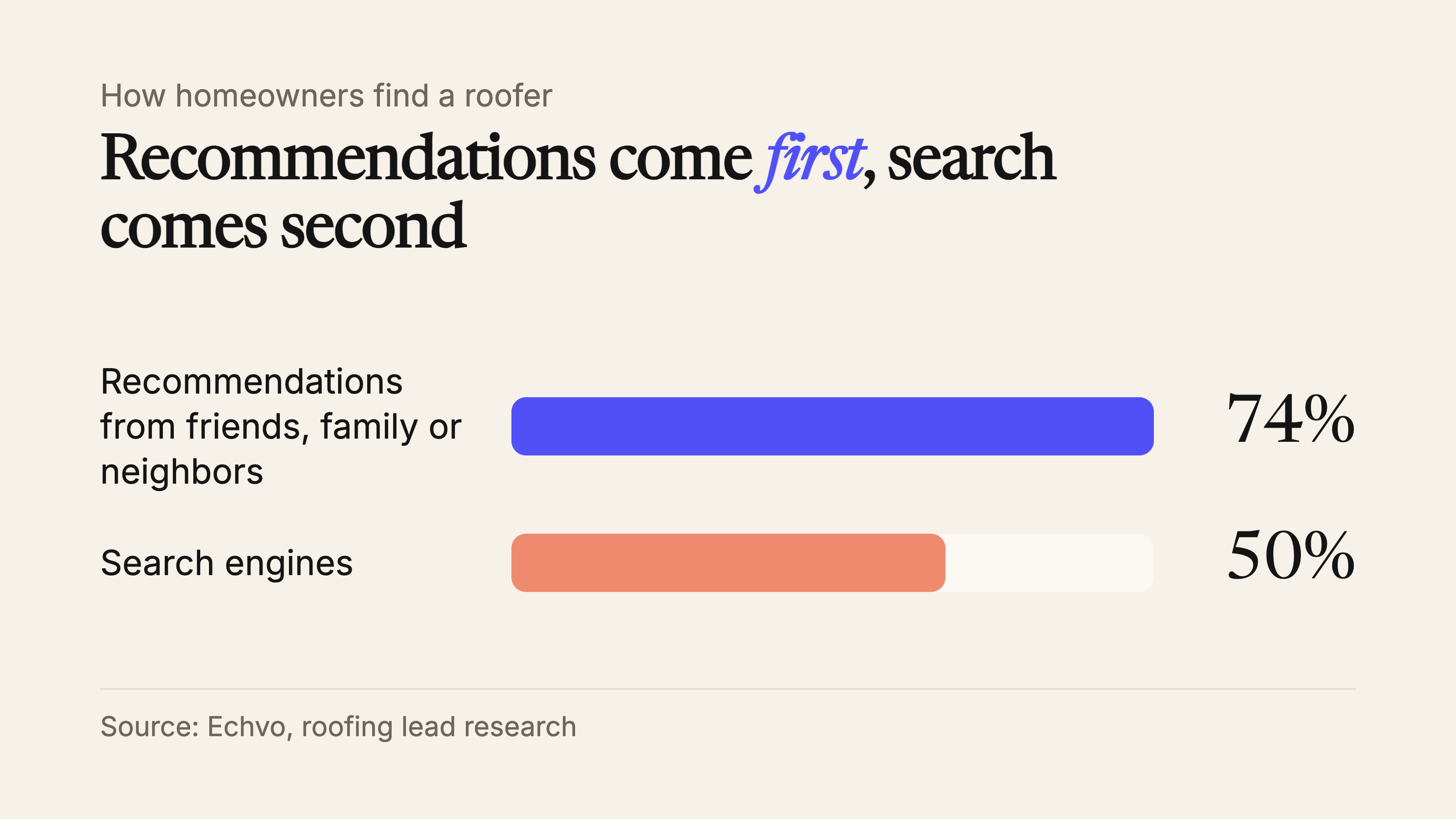
74% of surveyed homeowners said they found their roofer through recommendations from friends, family or neighbors, and 50% used search engines, per Echvo's roofing lead research. Survey wording shifts the split a little between studies. Recommendations sit on top either way.
The ask that doesn't feel pushy
Timing does most of the work. Ask at the final walkthrough, once the last payment clears and the yard is clean. The homeowner is standing under a new roof and feeling good about the decision.
Ask permission before you use their name or number with a neighbor. One sentence handles it: "Would you mind if I mentioned you down the street?"
Then leave something the homeowner can forward in ten seconds. A printed card with your direct line works. A personal link works better, because you can see when it gets used and which street it came from.
Number the steps so the crew repeats them
- Set the trigger. The ask happens on the final walkthrough, after final payment, before the invoice gets filed.
- Get consent. Permission first, for the name and the phone number both.
- Hand over a card or link. One card, one link, one number to call.
- Bundle the review request. Same message carries two asks: leave a review, introduce one neighbor.
- Log the referral. Referring customer, street, project type and date, in the same place your job records live.
- Compare quarterly. Referred-lead close rate against every paid channel you run.
"Thanks for trusting us with your roof. Who on your street should hear about us?"
Say a crew finishes eight jobs a month and asks every customer. The owner can count referrals per month and spot the streets that produce them. Within a year that count becomes a channel with its own close rate, and the crew knows the ask is part of the job.
For a walkthrough of the routine, watch the clip below.
A referred homeowner still types your company name into a search box before calling. Keep reviews and project photos current so that search confirms what the neighbor already said.
How to win local search leads for your roofing business
Local search leads come from a complete Google Business Profile, one page for each town and job type, and reviews that name the work and the place.
Homeowners comparing three roofers pick the company whose listing answers the question first. A thin listing loses to a fuller one in a crowded market, because the homeowner has no other way to judge.
The setup order that matters
- Claim and complete the profile. Service areas, hours, the phone number you track, and a description in plain words.
- Build one page per town. Each town gets its own page, with the town name in the title, the opening paragraph and the service list.
- Build one page per job type. Storm damage, leak repair and full replacement each answer a different question, so each earns its own page.
- Post photos with captions. A caption such as "hail-damaged shingles replaced, two-day tear-off" tells a browsing homeowner what the photo shows.
- Ask for reviews that name the job. "Full replacement after the June storm" beats "Great service" for a homeowner scanning results.
- Recheck every listing monthly. Wrong phone numbers and closed hours creep in when staff change, and each one costs calls.
What separates a page that ranks from one that sits
Search engines and homeowners look for the same two signals: does this company work here, and does it handle this problem? A single county-wide page answers neither question well. A page for one town and one job type answers both in the first paragraph.
Say a roofer has one generic page covering a whole county. A homeowner in a specific town sees a page that mentions 12 towns and none of them in detail. Six town pages with real project photos give each search its own clear match.
For the full local setup, including citation cleanup and page templates, get more roofing leads locally covers the parts that take the longest.
Every page ends the same way: a tappable phone number and one estimate button. The page has one job, and that's getting the homeowner on a call.
How to run paid search without wasting budget
Paid search works when each campaign matches one job type and sends every caller to a page built for that job.
Build four campaigns, not one
- Emergency repair. Written for the homeowner with water coming through the ceiling today.
- Storm damage. Separate budget and separate ads, because volume jumps after a weather event.
- Full replacement. Longer consideration, bigger ticket, financing questions.
- Inspections. Low intent on purpose, kept apart from the emergency campaign.
Restrict targeting to ZIP codes you can serve this week, and turn on call and location extensions. Send each ad group to its own landing page with reviews, license and insurance details, financing options, one estimate button and a tracked phone number.

Set your ceiling before you spend
The ceiling comes from your own books. Take expected gross profit on a sold job, multiply by your lead-to-sale rate, then subtract overhead and a buffer for crew downtime.
Say a job nets a solid gross profit and one lead in ten becomes a sold job. Divide that profit by ten and you have the break-even lead cost, and every dollar under it is margin.
Practical rule: work out the allowable lead cost before the campaign goes live, and write it beside the login for the ad account.
The benchmark you'll be measured against
LocaliQ benchmarked 3,211 U.S. search-ad campaigns. Roofing and gutter medians came out at $10.70 per click, a 5.66% click-through rate, a 3.70% conversion rate and $228.15 per lead, as compiled in Revved Digital's roofing marketing benchmarks. At that conversion rate, roughly 27 clicks produce one tracked lead.
Say an ad group receives 100 clicks this month. Expect about four leads, and multiply those clicks by the benchmark cost per click to see the spend before you commit. Set the monthly budget so four leads still makes sense on the ceiling you worked out.
Where the season moves demand
Homeowner searches shift with the weather. Storm-damage searches peak in August, roof-replacement-cost searches in July and roof-leak-repair searches in January, according to PipelineOn's roofing marketing review.
| Search topic | Reported peak month | Campaign to run around the peak |
|---|---|---|
| Storm damage | August | Storm-damage ads and an insurance documentation page |
| Roof replacement cost | July | Replacement landing page with financing options |
| Roof leak repair | January | Emergency leak ads with after-hours call handling |
Where budgets leak
- Forms with no usable phone number. A record with a dead number and no email is a cost with no contact path.
- Mixed intent in one campaign. Inspection traffic and active-leak traffic need different pages and different urgency.
- Verdicts too early. A campaign needs enough leads to reach a sales outcome before you judge the spend.
If the leak sits inside the account, how to stop wasting PPC budget covers the search-term audit that finds the waste.
How to answer every call and book jobs during the call
Answer every call quickly and book the estimate during that call. A slow reply burns a lead you already paid for.
The gap between five minutes and four hours
A contractor response-time study found leads contacted within five minutes were 21 times more likely to qualify than leads contacted after 30 minutes, per Customer Flows' contractor lead response study. The same study modeled 50 monthly leads at a 40% close rate.
| Response time | Qualified leads from 50 monthly leads | Deals at 40% close rate |
|---|---|---|
| Within 5 minutes | 30 | 12 |
| Four hours | 7.5 | 3 |
Those are modeled figures, so a shop with a 25% close rate on cheaper jobs will see smaller absolute numbers. The direction holds, and the cost of a slow reply stays.

Lead capture is where the money moves. Roofr reports that 52.2% of roofing companies said lead-capture tools such as instant estimators had a big impact in 2025, per its 2025 industry report summary.
Route calls by urgency
- Forward the business line. Point the main number at your answering option and keep the number customers already know.
- Sort by urgency. An active leak jumps the queue. A quote for next spring can wait until Monday.
- Capture the same details every time. Address, roof problem, timeline, insurance or storm context, budget and preferred appointment window.
- Book the open slot during the call. A homeowner who has a date on the calendar stops calling other roofers.
- Text a confirmation. Date, time, and who will show up.
- Review time to first response weekly. The number tells you whether the routing works.
Your three answering options
Office staff, an answering service, or an AI receptionist such as Sarah from Ansa, who checks the service area and budget, takes down what the caller needs, and books the right slot around the clock. The Hartman Team contacts 100% of its leads within five minutes using that setup, and setup itself starts with forwarding the business line, so the business keeps its own number.
Say a crew is on a roof when a leak call comes in. Sarah offers the next open estimate slot, books it, and puts the active leak through to the owner's phone. Nobody leaves voicemail in the middle of a tear-off.
The recovery work is measurable at each stage: was the call answered, did the caller give a qualified project, did the inquiry become a booked estimate.
The missed-call statistics collection gathers 49 published figures on how often service businesses miss calls and what callers do next, each credited to its original publisher. Those numbers size the problem. They don't establish roofing conversion rates, so track your own.
An answering service for contractors covers the routing setup in more depth.
Pick one lead source to fix this week
Fix the weakest link in the lead flow this week, track one number, and review the result after 30 days.
Start by naming the weak link. Slow calls, thin reviews, no referral request, no town pages. Pick the one that loses the most work and leave the others alone for now.
Choose the number before you change anything. Minutes to first response, booked estimates by source, referral count per month. Write it down, along with today's value, so the comparison means something later.
Then run the change for two weeks and resist judging it early.
Say a roofer finds that calls after 4 pm go to voicemail. Route after-hours calls to an answering option and count booked estimates for 30 days. Compare that count with the month before, then keep the change if the count rises.
If an answering option is the fix, check the terms first. Ask what counts as a qualified call, because a definition that includes solicitors and wrong numbers flatters the numbers. Under Ansa's Booked-Jobs Guarantee, an account that meets the Qualified Call Minimum over a 14-day period from checkout and books nothing can claim a refund of the first monthly fee or one extra free month, with one claim per account. Read that wording before you sign, and get a written quote before you commit to any monthly service.
A Henson Roofing case study shows a shop that booked $47,000 in jobs after one storm. The full answer to how to get more roofing leads fits on one page: two funded channels, one tracked number, and a phone that gets answered.
Ansa answers the phone when your crew is on a roof. Sarah, Ansa's AI receptionist, picks up every call around the clock in English and Spanish, asks about the leak or storm damage, checks the service area and budget, and books the inspection straight into your calendar. Visit Ansa to see how a call at 9 pm on a storm night turns into a booked estimate.