
A law firm intake service answers the call, checks whether the firm handles that kind of matter, and either books a consultation or passes the call to an attorney right away. It asks the same questions in the same order every time, so a caller never waits for a free receptionist. The surprise is that the design decides the outcome far more than the speed does. Firms buy faster answering, then watch a calendar fill with callers they can't help. Practice area, other-party names, deadline, and location come before any consult is booked. Urgent transfers run on their own path, separate from routine bookings. This guide walks the full route from first ring to signed client, names who handles each step, and covers what the service costs and what to ask before signing.
Table of Contents
- What a law firm intake service does for the owner
- How a caller becomes a signed client
- Which legal calls need an attorney right away
- How much does a law firm intake service cost?
- What an after-hours intake call looks like
- How to choose a law firm intake service
What a law firm intake service does for the owner
An intake service answers the firm's inbound calls, checks whether the matter fits the practice list, and books a consultation from the firm's calendar when it does. An urgent call reaches a number the firm names, during that same call.
The owner gains hours back. You're in a deposition or with a client, and the call still ends with a name, a phone number, and a consult time. Work that used to wait for a callback gets scheduled while the caller is still talking.
The same pattern runs across service trades. In Invoca's 2021 aggregate customer data, published on Ansa's missed-call statistics page, 26% of calls from potential customers went unanswered across industries. Read that as a cross-industry benchmark from one vendor's customer base. It's a way to frame your own count of missed calls, not a forecast for your firm.
For a law office the loss runs deeper than one conversation. An unanswered call carries no practice-area check, no other-party names for the conflict screen, and no consultation on the books. The caller dials the next firm and never comes back.
Split the roles before you shop. Three parties touch every intake:
- The service answers and writes. It uses the firm's questions and records the answers where staff can read them.
- Staff clear the conflict check and hold the calendar. A note from a caller is a lead. A cleared conflict is a decision.
- An attorney takes the matter and gives the advice. Nothing in an intake script crosses that line.
Some owners see modest inquiry volume and assume intake isn't their bottleneck. When search visibility is the constraint, Digital Skyrocket's law firm SEO covers how more of the right callers find the firm in the first place. Intake then decides what happens when they dial.
What follows is the route a caller takes from first ring to signature, the details to collect and the order that matters, the split between urgent and routine calls, what a service costs, a worked night of after-hours calls, and the questions to ask before signing a contract.
How a caller becomes a signed client
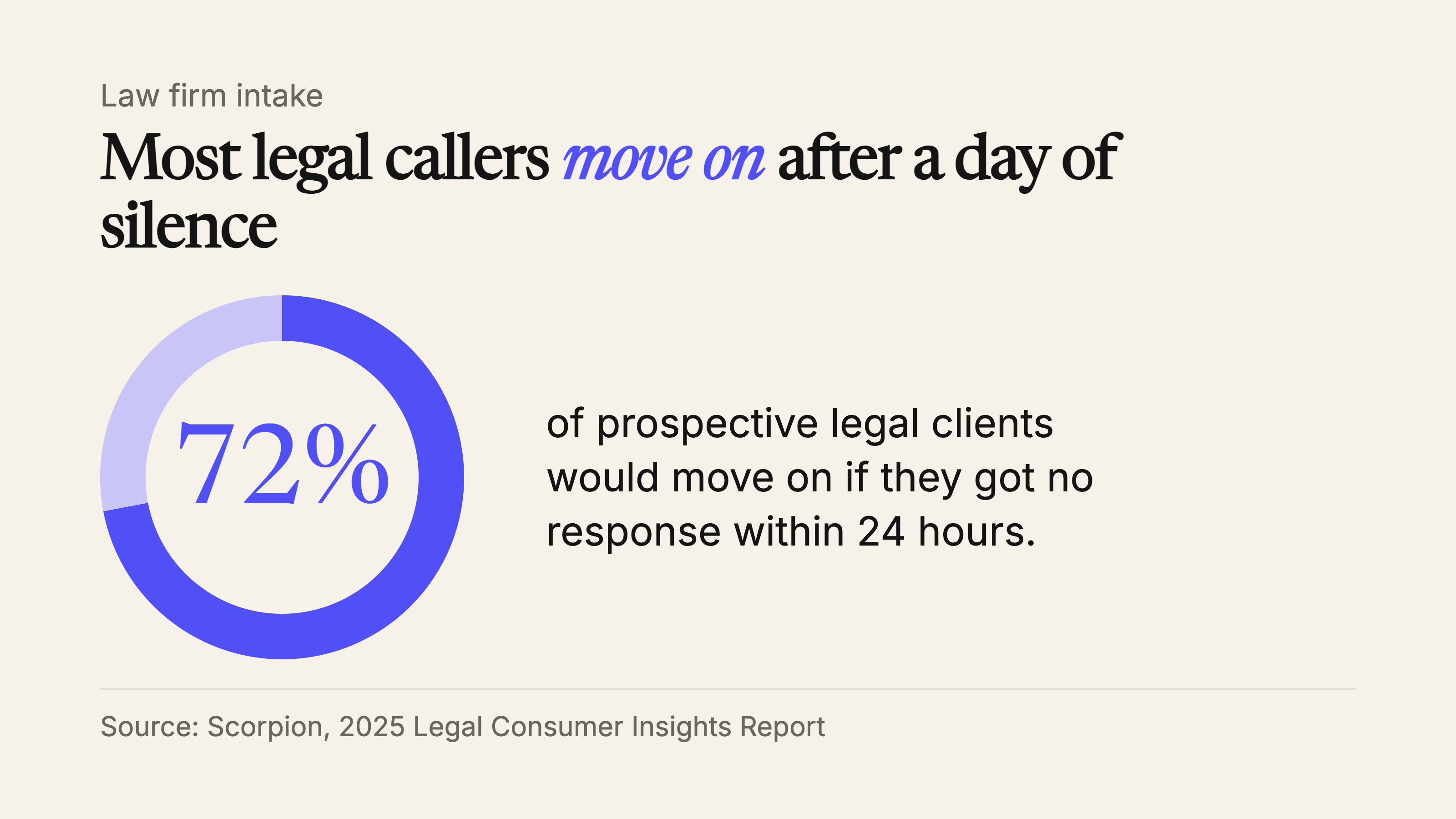
Nine steps separate a ringing phone from a signed client, and a firm can run them in under ten minutes. The order does most of the work. Scorpion's 2025 Legal Consumer Insights Report found that 72% of prospective legal clients would move on if they got no response within 24 hours, and more than one-third expected a same-day callback. Response-time testing of law-firm websites points the same way: many firms reply slowly, and some never reply at all.
So the clock runs while the caller is still choosing. A firm can answer fast and still book the wrong people. Speed and fit are two separate jobs, and the script has to do both.
The nine steps from ring to retainer
- Answer on the first ring and use the firm's name. A caller dialing three firms remembers the one that sounded like a law office.
- Ask the practice area before anything else. A firm that doesn't handle the matter stops here and takes a message. Say a firm gets 120 calls a month and 30 fall outside its practice list. Those 30 leave a note for staff, and the consult calendar stays open for work the firm can do.
- Take a name, a phone number, and an email address. One callback number fails when the caller is at work, so ask for a second one.
- Write down the other parties' names. Add a company or insurer when the caller knows it. Those names feed the conflict screen, and staff still run and clear that check.
- Ask about a deadline. Any date a court or an opposing party has already set changes what happens next.
- Ask where the matter is located. Get the state and county when the work depends on the courthouse or the licensing board.
- Book or transfer, using the firm's written rule. A routine fit takes the next open consult slot. An urgent fit goes to the named number while the caller is still on the line, and the two paths never mix.
- Land the note in the file before the next call arrives. That means the CRM, the case management system, or a shared inbox somebody reads.
- The attorney meets the caller, decides, and sends the engagement agreement. A signed client exists at step nine. Everything before that is intake.
Booking rule: if practice area, other-party names, deadline, or location is blank, the call doesn't get a consult. Fill the gap first.
Why those four fields come first
The four fields work like a filter before a pump: catch the wrong matter early and nothing downstream clogs. Each one removes a different kind of wasted hour. Practice area keeps unsuitable matters off an attorney's calendar, and it's the one question a caller can answer in five seconds. Other-party names protect current clients, because a firm can't screen a conflict it never recorded. Deadline catches the matters where a week of delay can end the case. Location sets jurisdiction, travel, and whether the firm is licensed to act at all.
Location looks optional for a firm licensed statewide. It isn't. The county often decides which courthouse, which filing office, and which attorney takes the consult, and a caller who names the wrong venue still leaves a usable note.
Budget sits outside the four. A price conversation at intake anchors a caller before an attorney has read the facts. Read the firm's published minimum fee if one exists and leave the rest to the consult. One more field earns a line in the note: how urgent the caller says the matter is. That answer routes the call in step seven.
Intake qualifies a caller for a conversation. An attorney answers the legal question.
What the note looks like on a Monday
A useful intake note fits on one screen:
- Matter: the practice area in the firm's own labels, such as "auto injury" or "estate planning".
- People: caller name, callback number, email, and every other-party name the caller gave.
- Timing: court dates and service dates written as dates, never as "soon".
- Place: city, county, and state.
- Status: booked, transferred, or messaged for staff, with the time.
A note that reads "caller asked about an accident" forces the next person to start over, and the caller repeats a story they didn't want to tell twice. Language and distress belong in the handoff too. A caller with limited English or no internet access needs a human next step rather than a self-service link. Response-time strategies from LegalRev cover what should happen between that first call and the booked consult.
The wider market shows how much room exists. In a 2024 Clio secret-shopper study of 500 U.S. law firms, only 40% of firms answered prospective-client phone calls. A firm that answers, asks four questions in order, and books on the call starts well ahead of most of its local market.
Which legal calls need an attorney right away
The firm sets the rule, and the service follows it during the call. Most firms split every call into two paths: transfer now, or book a consult.
| Call type | How to treat it | Who receives it | What intake may do |
|---|---|---|---|
| Arrest or person in custody | Urgent | Attorney or on-call number | Transfer during the call |
| Hearing or filing deadline within a day or two | Urgent | Attorney or on-call number | Note the date and transfer |
| Papers just served with a short response time | Urgent | Attorney or on-call number | Note the deadline and transfer |
| New inquiry with no deadline | Routine | Calendar consult | Book an open consult |
| Matter outside the firm's practice list | Do not book | Message to staff | Take a message only |
| Wrong number or sales call | Screen out | No consult | End the call or take no lead |
The test is the situation, not the hour. Say a caller reports a court date tomorrow morning. That call is urgent at 9 p.m. the same way it's urgent at noon. Say another caller wants a will and names no deadline. That call is a consult, booked for the next open slot, and nobody gets paged.
Two hypotheticals cover most arguments about the rule. A Friday-night arrest call is the clearest transfer a firm will ever see. A caller asking whether a contract clause is enforceable wants a legal answer, and that answer comes from an attorney, so the call goes to the review list.
Some calls sit outside the usual three. Domestic situations, active cases, and any request for legal advice belong on the firm's review list even when they don't match an arrest, a filing date, or fresh service. Intake can ask how urgent the caller says the matter is and then follow the written rule. It can't decide what the caller should do.
Test before launch: place three sample calls, one for each urgent type, and check where each one lands. Fix the routing before the first real Friday night.
Write the destinations down and hand the list to whoever builds the script. Change the rule when the attorneys disagree with a transfer, and change it in writing so the next call follows the new version. The table above works as that rule sheet.
How much does a law firm intake service cost?
Expect a monthly plan, and get the number in writing, because a public page rarely matches your call volume and your rules.
What moves the price is straightforward. Plans that put a person on the line usually bill by the minute, so a busy month costs more than a quiet one. Software that answers, qualifies, and books often carries a flat monthly fee that doesn't change with call count. Ansa lists its plans on its pricing page, where the Done-for-you plan costs $497 per month and is built for one business.
Ask these questions before you compare anything:
- After-hours coverage: is a Saturday night inside the fee, or billed separately?
- Languages: are English and Spanish included, or is Spanish an add-on?
- Booking: does the service write straight into your calendar or CRM, or send a message for staff to book?
- Urgent transfers: which numbers receive them, on which days, and is there a charge per transfer?
- Minutes over the cap: does the service keep answering and take a message, or bill overage?
- Setup: included in the monthly price, or a one-time fee?
- Scope: how many phone numbers and how many legal entities does one subscription cover?
- Term: month-to-month, or a multi-month commitment?
The minute cap deserves a second look. A firm with a heavy Monday can burn a monthly allowance in a week, and the behavior after that point decides what callers hear. Some plans keep answering and take messages until the month resets. Others bill the extra minutes. Ask which one you're buying.
Compare two written quotes only when both cover the same jobs: answer, qualify on practice area, capture other-party names, book the consult, and escalate the urgent calls. A cheap plan that only takes messages covers a smaller job than one that fills the calendar. Price the job you need.
This article doesn't rank vendors. A separate post covers named legal answering services in detail. The useful move here is to request two written quotes that name the numbers covered, the practice areas loaded, and the urgent-transfer rules.
What an after-hours intake call looks like
Take a made-up firm for this walk-through: an injury office that stops answering at 6 p.m. Every call described here is an illustration.

On a Friday night, several people call about a crash after the office has closed. With voicemail only, those messages sit until Monday morning, and some callers reach another firm before then. With intake answering, each call gets picked up that night.
The service confirms the matter is a personal-injury claim on the firm's list. It writes the other driver's or insurer's name for the conflict check. Injuries get noted in the caller's own words, without any attempt to assess them. It asks about a deadline or court date and where the crash happened. Callers with no same-day emergency get a consult on the next open day. Callers who match the firm's urgent rule go to the on-call number during the call.
Firms that want the whole night covered can read how after-hours answering works with the number the firm already has.
A short walkthrough shows the shape of that conversation:
By Monday, the file holds a short note showing who is booked, who was transferred, and which names still need a conflict check. For the owner, after-hours callers reach a next step the same night, and routine questions wait for business hours without waking the partner who has a hearing at nine.
How to choose a law firm intake service
Work through this checklist before you sign, and confirm each answer in writing.
- Practice area is required before any booking. If a provider can book without it, the calendar fills with matters the firm can't take.
- Other-party names are stored for the conflict check, and staff still make the final clearance.
- Transfer rules are written for nights and weekends, with a named number for each urgent type.
- A spoken disclaimer covers the relationship. The caller should hear that the intake call doesn't form an attorney-client relationship and that the service gives no legal advice.
- Access and retention are clear. Ask who can open transcripts, whether audio is stored, and when notes are deleted.
- Languages and plumbing fit the firm. English and Spanish, the firm's existing number through forwarding, and booking into the calendar you already use.
Point four carries real weight. The Washington State Bar Association's ethics guidance on lawyer chatbots advises firms to consider a disclaimer that no attorney-client relationship has been formed, to explain whether submissions are confidential, and to vet a tool's security before sensitive facts go into it. A fast system that invites detailed disclosures before those limits are explained creates work for the firm's ethics counsel.

Ansa's AI receptionist, Sarah, is one option that fits this pattern. Sarah answers every call, speaks English and Spanish, and asks the firm's exact intake questions. She doesn't give legal advice; on those calls she asks only how urgent the caller says the matter is and sends the call to the owner. Firms comparing that against a human law firm virtual assistant are weighing two different jobs, since a paralegal can prepare documents while an answering layer only captures and books. See how the AI receptionist for law firms handles matter type, deadlines, and opposing-party names.
Then run the setup in order. Forward the firm line, load the practice areas and urgent rules, place three test calls, and read every note before you rely on the service for a full week.
Ansa answers law firm calls around the clock with an AI receptionist that asks your intake questions, notes the other parties for your conflict check, and books consultations into your calendar. Urgent calls follow the rules you set and go straight to your phone. Visit Ansa to hear how a live call sounds before you change anything about your phone line.