
An answering service for plumbers picks up your business line while crews are on jobs, books routine appointments, and routes true emergencies to your cell phone. Picking the right provider comes down to its written emergency list, intake questions, and call logs, because those rules control which calls wake up a technician and which jobs fill tomorrow's schedule.
Most plumbing shops run lean teams where the owner, dispatcher, or lead technician works in crawl spaces and drives between properties all day. According to Simpro's 2026 plumbing industry statistics, the U.S. market includes 129,000 to more than 132,000 plumbing businesses, and roughly 70% to 80% of plumbing service calls are urgent or can't safely wait for ordinary business hours. When a phone rings unanswered during a pipe repair, the caller moves down the search results. Clear triage rules keep urgent work moving to an on-call truck while routine estimates land neatly on your calendar.
Table of Contents
- What an answering service changes for your shop
- How a call moves from the first ring to a booked job
- Which plumbing calls count as emergencies
- How much does an answering service cost for plumbers?
- Questions to ask before you sign
- Red flags that mean you should walk away
- Run a short test before you commit
What an answering service changes for your shop
An answering service picks up every inbound call, books routine jobs directly on your schedule, and sends urgent emergencies straight to your phone. Your crew stays focused on active repairs while new service requests turn into confirmed work orders.
Owners notice three immediate operational changes once live call coverage replaces voicemail:
- Fewer calls hit voicemail: Every caller reaches a responsive voice right away, whether technicians are under a sink, driving across town, or off the clock.
- Jobs get booked during the call: Routine drain cleanings, toilet repairs, and estimate visits land directly on your calendar without waiting on an end-of-day callback list.
- Emergencies reach you while routine calls wait: Urgent flooding or sewage backups trigger an immediate escalation, while non-urgent requests wait cleanly for the next open slot.
Here is how an organized front-office setup looks when inbound calls and field schedules stay connected.
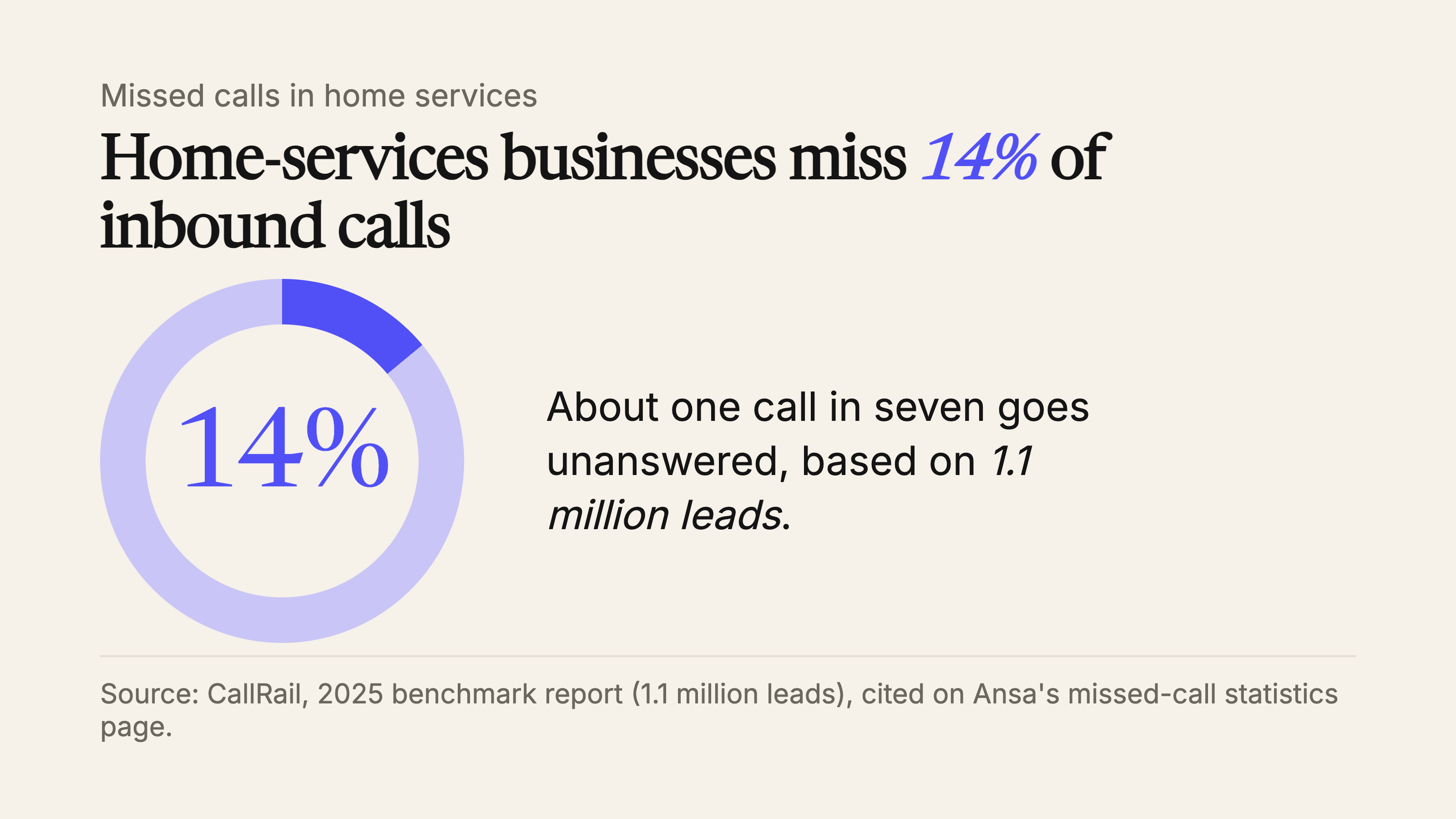
How missed calls add up for a working shop
Say a shop gets 120 calls a month and misses one call in seven. That equals roughly 17 unanswered calls every month where a homeowner may hang up and dial another contractor.
CallRail's 2025 benchmark report, based on 1.1 million leads and cited on Ansa's missed-call statistics page, reports that home-services businesses miss 14% of inbound calls. A missed call doesn't automatically equal a lost job, since some callers try again or leave a message. Even so, that 14% gap represents a clear, measurable chance to capture paying work that currently leaks out of your phone line.
Practical benchmark: Measure missed calls against your monthly booking rate over four weeks before changing anything. Real call logs show exactly when your shop drops leads.
Seeing how an established contractor handles inbound call volume helps clarify the payoff. The Velez Plumbing case study shows how structured call coverage keeps appointments flowing while technicians stay in the field. Once you understand how many calls slip through voicemail, the next priority is mapping the exact path from the first ring to a booked job.
How a call moves from the first ring to a booked job
Sarah answers on the first ring, asks a fixed set of intake questions, and sends each caller down the exact route your shop defines. Callers hear your business name right away, and every answer determines whether the call triggers an alert, a calendar booking, or a message.
Businesses keep their own phone number by forwarding their line to Ansa, so callers dial the same number as before. Sarah answers calls 24/7, including weekends and holidays, and picks up on the first ring so callers never land in voicemail. That immediate pickup matters for conversion: Invoca's 2026 Home Services Lead Conversion Benchmarks Report finds that 38% of answered home-services calls are genuine leads, and 45% of those leads convert during the initial call.
The visual below outlines the core path an inbound plumbing call follows from initial pickup to scheduling or escalation.

The nine-step plumbing call flow
A structured intake sequence keeps calls short, accurate, and actionable for your dispatch board:
- First-ring greeting: Sarah picks up immediately in English or Spanish and greets the caller using your company name.
- Active symptom check: She asks what is happening right now so the caller describes the exact plumbing issue.
- Water status check: She asks whether water is still actively running or leaking.
- Timing and urgency: She asks when the caller needs a technician at the property.
- Service-area verification: She checks the street address and zip code against your approved territory before offering any time slots.
- Contact capture: She records the caller's full name and callback number so your team has verified details even if the line drops.
- Rule-based sorting: She routes the inquiry according to your policy. Active emergencies go straight to your cell, urgent active problems take the first open slot, and remodels or quote shoppers get an estimate visit.
- Direct calendar booking: She places qualifying jobs straight into your connected calendar. If the caller requests a service outside your list, she records a clear message for office review.
- Instant owner summary: You receive a text notification with the booking details, accompanied by a written transcript and a short summary in your dashboard.
Every question in steps two through five shapes the outcome. Those sorting questions separate a homeowner standing over a broken supply line from a property owner gathering three bids for next month's bathroom remodel. Asking them in a fixed order keeps your schedule clean and saves your technicians from driving out to unqualified leads.
What gets collected before waking an on-call plumber
Nighttime interruptions burn out good technicians fast when details are incomplete. Before Sarah wakes up an on-call plumber, she collects five specific facts:
- Exact problem: What is leaking, backing up, or failing right now.
- Shutoff status: Whether the main or fixture water valve is turned off.
- Location and access: The full street address along with gate codes or entry notes.
- Caller name: Who the technician should ask for on callback or arrival.
- Callback number: The best direct phone line to reach the homeowner.
With those five details in hand, the on-call plumber decides in seconds how to respond and knows where to drive. Say a homeowner calls at night reporting water leaking under a kitchen sink into a bucket, and the angle stop valve is seized. Sarah notes the active leak and the stuck shutoff valve, confirms the street address, and passes the call directly to the on-call plumber with full context.
After-hours calls that turn into next-day revenue
Many evening and weekend calls involve contained problems that homeowners want solved the next morning. Common examples include a water heater that stopped heating, a sluggish or clogged drain, a constantly running toilet, and a slow under-sink drip caught by a bucket.
Homeowners dealing with those frustrations rarely leave voicemails and wait until morning. They book with the first plumbing company that answers tonight and confirms a morning arrival window. For a deeper look at turning live phone inquiries into scheduled appointments, review this guide to booking jobs by phone.
Watch the short video below to see how automated intake captures caller details and fills open service slots without manual retyping.
Which plumbing calls count as emergencies
Five plumbing situations go straight to your on-call phone, and every other call waits for a booked appointment slot. The shop owner sets the exact escalation list, and Sarah follows those boundaries consistently around the clock, 365 days a year, taking messages and flagging qualifying emergencies.
Defining these boundaries protects both emergency revenue and crew morale. According to Anytime Plumbing's 2026 U.S. plumbing industry statistics, emergency work accounts for about 35% of all plumbing calls, roughly 40% of emergency calls arrive after normal business hours, and emergency visits commonly bill at 1.5 to 2 times standard rates. Speed also counts when water is spreading: AgentZap's 2026 emergency plumbing call statistics note a 45-second tolerance for emergency callers before they abandon the line.
The table below lays out the five core escalation triggers alongside contained issues that belong on tomorrow's schedule.
| Symptom | Why it is urgent | What Sarah does |
|---|---|---|
| Burst or leaking pipe you cannot shut off | Water keeps spilling into the home | Escalates to the on-call phone at once |
| Sewage backing up into the house | Health risk and property damage | Escalates to the on-call phone at once |
| No water at all | The household cannot use water | Escalates to the on-call phone |
| Leaking water heater | Water spreads and the unit can fail | Escalates to the on-call phone |
| Gas smell | Fire and explosion risk | Gives approved safety guidance, then escalates at once |
| Running toilet, clogged drain, or slow leak with a bucket | Annoying but contained | Books the next open slot |
Handling safety scripts and unclear callers
Gas-smell calls require strict boundaries to protect homeowners and limit your shop's liability. Sarah delivers only the exact safety guidance you approve in writing, such as advising the caller to leave the building immediately and contact emergency services or the local gas utility, and then escalates the alert at once. No receptionist should improvise troubleshooting steps around gas appliances or electrical hazards.
Unclear calls follow one simple tie-breaker rule. If water is still running and the caller can't shut off the valve, treat the situation as urgent and escalate it. When a caller can stop the flow or safely contain a slow drip with a bucket, the call moves into the next available daytime slot.
Updating your list before winter and across service areas
Clogged single fixtures and running toilets should stay off your on-call cell at midnight. Routing those contained calls to next-day bookings protects technician sleep so your crew stays sharp for high-margin emergency dispatches.
Review your written emergency list every autumn before freezing temperatures arrive. Hard freezes bring cracked exterior hose bibs, burst garage lines, and sudden multi-day call spikes. Before signing with any provider, check how you edit your emergency list and confirm how fast those edits go live.
Shops expanding emergency coverage into neighboring towns should also keep their online service details aligned with their phone routing. Pairing clear intake territories with local pages and schema for plumbers from AISEOGrow helps homeowners in each municipality reach the right local number during an active leak.
How much does an answering service cost for plumbers?
Most answering services bill a flat monthly fee or charge by usage, so compare the billing model before comparing the dollar amount. Two providers with similar starting numbers can produce very different monthly invoices once call length, holiday volume, and freeze-week surges hit your phone line.
This guide includes no estimated price bands because provider rates vary widely and change frequently. Ask every vendor for a written quote that details setup fees, monthly call or minute limits, overage rates, and cancellation rules. Check each company's own pricing page directly before making a comparison, since third-party summaries quickly go out of date.
| Billing model | How it charges | What to check |
|---|---|---|
| Flat monthly subscription | Fixed fee each month, often with a call or minute allowance | Overage rules and what happens after the allowance |
| Usage-based per minute | Charged for the minutes used | Peak-hour rates and how short calls are counted |
| Per booked job | Charged when a job is booked | How a booking is defined and how duplicates are handled |
| Setup plus monthly | One-time setup fee, then a monthly fee | Whether setup is refundable and who sets up the emergency rules |
Understanding renewal and overage rules
Paid subscriptions typically renew monthly until the customer cancels. Read the exact billing trigger for extra usage before forwarding your main line, because plumbing intake calls often run longer than simple message-taking calls. Explaining a shutoff valve location, verifying a street address, and confirming an arrival window takes real talk time.
Pay close attention to how each provider treats short hang-ups, robocalls, and wrong numbers. Some usage-based plans round every call up to the next full minute, which inflates bills during spam waves. For a closer breakdown of how different fee tiers behave across trade businesses, review this overview of answering service pricing structures.
How to run your own per-job cost check
Skip generic return-on-investment claims and test the math against your own accounting records. Divide the total monthly answering fee by the number of completed jobs booked through the service, then compare that cost per booked job against the average gross profit margin in your books.
Say a shop pays a flat monthly fee and books 20 jobs through the service in a single month. Dividing that monthly fee by 20 gives the exact acquisition cost per booked job. Compare that figure against your real average ticket margin for water heater repairs, drain clearings, and emergency leak calls.
Judge an answering service by incremental booked jobs and gross profit over 30 to 90 days. Raw answer rates mean little if the calendar fills with low-margin or out-of-area appointments.
Auditing hidden costs during the first 90 days
Track four operational numbers alongside your monthly invoice during the first three months:
- Duplicate bookings: Count how often the same customer gets scheduled twice because calendar sync lags behind phone intake.
- Out-of-area dispatches: Flag any appointment booked outside your zip-code boundary, since long drive times erase job profitability.
- Below-minimum tickets: Check whether callers received your accurate trip fee and minimum service charge before grabbing a slot.
- Cancellation rate: Compare cancellation rates on service-booked slots against office-booked slots to see whether arrival windows were communicated clearly.
Questions to ask before you sign
Ask these eight questions during your vendor call, and get every single answer in writing before signing an agreement. Written answers keep expectations clear when a busy storm week hits your phone line.
- Emergency ownership: Who answers an emergency call, and who sets the shop's emergency list?
- Rule updates: How can the owner update the emergency list, and how fast does a change take effect?
- Unknown requests: What happens when a caller asks for a service the shop doesn't offer, or asks a question outside the approved script?
- Calendar access: Does the service book appointments directly into your scheduling calendar, or does it only take messages for callbacks?
- Allowance limits: What happens to incoming calls the moment your monthly minute or call allowance runs out?
- Number retention: Can your shop keep its existing business phone number through standard call forwarding?
- Call records: Where are call transcripts stored, and how long can your office access them?
- Exit terms: What are the exact cancellation rules, refund policies, and trial options?
How to tell a strong answer from a weak one
Vague responses to questions two and three are an immediate warning sign. A weak sales rep says their team handles changes quickly or figures out tricky questions on the fly. A strong provider points to a specific dashboard page, names who makes the edit, and confirms the exact turnaround time.
Look for strict discipline on unknown questions as well. Sarah never makes up an answer; when she doesn't know one, she takes a callback request, writes down the caller's exact question, and sends it to the business by text or email. That rule protects your reputation when a caller asks about custom commercial quotes, permit fees, or specialized pipe materials.
Verification standard: Ask to see a sample call transcript and summary before you forward a single customer call. Every call should produce a written transcript and a short summary in your dashboard so you can review accuracy in seconds.
Checking calendar and service-list alignment
Confirm exactly what lands inside your calendar or field-service software when a routine job books. Some providers drop a basic text note into an email inbox, forcing your office manager to retype the customer name, address, and problem description manually. True calendar booking checks real open windows and writes the appointment with all intake fields attached.
Also verify how out-of-scope services get handled. If your crew skips septic tank pumping or commercial grease traps, the receptionist should log a polite message or decline clearly while keeping your schedule open for core residential work.
Red flags that mean you should walk away
Walk away from any provider that can't name its emergency triage rules or refuses to put them in writing. Plumbing calls carry asymmetric risk: a routine faucet inquiry can safely wait for tomorrow's schedule, while an active burst pipe, sewage backup, or no-water condition requires immediate human intervention.
Response speed directly shapes whether a caller hires your shop or dials a competitor. A neutral industry benchmark summary on Octopi Digital's missed-call statistics page cites research showing that leads contacted within one hour were nearly seven times more likely to qualify than leads contacted after an additional hour, and roughly 60 times more likely than leads contacted after 24 hours or more. Dropping an urgent homeowner into a slow callback queue puts both the customer's property and your dispatch revenue at risk.
The graphic below highlights the two deal-breaking gaps to watch for when evaluating emergency call coverage.

Warning signs to check before forwarding your line
Stop the buying process immediately if you spot any of these operational gaps during a demo or contract review:
- No written emergency list: Request the exact symptom-by-symptom escalation policy in writing, and move on if the vendor keeps it vague.
- Callback promises on active leaks: Require live transfer or redundant phone-and-text escalation for active flooding, sewage, and no-water calls.
- Invented prices or guesses: Confirm the system refuses to guess on unapproved pricing and sends a written callback request to your team.
- No transcript or call log: Require accessible written transcripts so you can audit dispatch fields, escalation speed, and caller consent.
- Silent drops into message mode: Ask what happens when your plan limit ends, because in message mode a service answers questions and records caller details while pausing appointment bookings, changes, and cancellations.
- Long contracts with rigid exit terms: Push for month-to-month billing or a documented trial window before committing your main phone line.
- Unsourced performance claims: Ask for the original publisher behind any conversion or revenue statistic, and disregard unverified sales figures.
Auditing performance after launch
Even a strong vendor deserves regular spot-checks during your first month. Review weekly logs for five concrete health checks: answer speed, hang-up rate, emergency-escalation delay, duplicate bookings, and the share of calls containing all required dispatch fields. A dependable provider shows its written rules, its complete call logs, and its operational limits up front.
Run a short test before you commit
Write your emergency list today, then run a short live test before committing to any long-term service. Testing a provider on real inbound calls exposes script gaps, calendar friction, and alert delays far faster than any sales presentation.
Follow these four practical steps to evaluate your options cleanly:
- Draft your rules first: Write down your five emergency triggers, your approved gas-smell guidance, your service-area zip codes, and your core intake questions.
- Interview two or three providers: Run every company through the eight-question checklist and collect each answer in writing.
- Run a controlled 30-day test: Request a trial period, or forward one business line or after-hours window for 30 days to see live performance.
- Audit the numbers weekly: Log total booked jobs, missed calls, emergency escalations, and transcript accuracy at the end of every week.
Ansa is built for owner-run service businesses, including plumbers, HVAC companies, electricians, roofing contractors, and similar trades. Its AI receptionist, Sarah, works as a plumbing answering service that answers on the first ring in English and Spanish, books routine appointments into supported calendars, and escalates urgent calls directly to the owner's phone.
Confirm every trial window, refund policy, and cancellation term in writing before flipping your call forwarding switch. Bring your written emergency list and live calendar to the very first call with each provider so you test how they handle your shop's actual work.
Sarah answers your plumbing line around the clock in English and Spanish, screens emergencies using your exact list, and books routine service visits straight into your calendar. Visit Ansa to test how first-ring answering and structured plumbing intake work for your shop.